What a Second Story Strategy™ Actually Is
For the last couple of years, I’ve been a little obsessed with one question.
Why are some companies becoming genuinely empowered by AI … while others are working twice as hard and barely keeping pace?
I study AI for a living. I research companies, I read the reports, I sit with leaders, and I listen. Lots of listening, in fact. And what I kept seeing didn’t match what I expected to see. Some teams were transforming what they do. Others were running harder than they’ve ever run and not really moving (the corporate equivalent of a Peloton that’s become more coat hanger than bike). Same tools, broadly. Same access. Wildly different outcomes.
My first guess was the obvious one. I assumed the companies pulling ahead would be the most technically advanced, the ones with the biggest AI budgets, or the ones with the deepest engineering benches. Reasonable hypothesis. Completely wrong. (I have a lot of these, ask my husband.)
Take Klarna. In February 2024, the buy-now-pay-later company announced something that made every cost-conscious executive sit up. Their new AI assistant was doing the work of 700 full-time customer service agents, handling 2.3 million conversations in its first month, in 35 languages, cutting resolution time from 11 minutes to under 2. The company projected a $40 million profit improvement, and the CEO became, for a while, the most quotable champion of AI replacing human work the business press had. Bold, well-resourced, technically sharp, first to move. Exactly the profile I’d assumed would win. Hold that thought, because the rest of the Klarna story is the most useful part, and it didn’t arrive until 2025.
What I found instead was that the companies genuinely thriving with AI weren’t winning on tech sophistication or spend. Several of them were the kind of organizations you’d describe as “solid” rather than “shiny,” to be honest. What they had in common was something subtler, and something I didn’t see at first because I was busy staring at the wrong layer of the building.
They weren’t using AI to keep pace. They were using it as a springboard. They weren’t standing on the rising floor and hoping to stay upright. They were climbing the stairs to a Second Story.
Once I saw the pattern, I couldn’t unsee it (the way you can’t unsee the FedEx arrow once someone points it out). The more companies I looked at, the more clearly the pattern held. So I named it, mapped the moves the standouts kept making, and built an architecture around it. That’s where the Second Story Strategy™ came from.
The companies thriving with AI weren’t winning on tech sophistication or budget. They were using AI as a springboard, not a treadmill.
The Floor Everyone Is Standing On
AI is raising the floor for everyone. Your competitors have access to the same models you have, the same agents, the same automation, the same generative output. They can answer customer questions, draft proposals, analyze data, and write code at roughly the same speed you can … usually with roughly the same tools. The floor is rising fast, and it’s rising the same amount for everyone in the building. Yes, even the competitor you don’t take seriously.
Which is actually wonderful news, when you think about it. The bar of basic capability has never been higher, and that’s a real gift (something we don’t say enough). But standing on a rising floor isn’t a competitive position. If you do well, you keep pace. If you do less well, you fall behind. Either way, you end up looking very much like every other organization in your category, which is fine if your goal is to blend in and a bit of a problem if it isn’t. (“We’re just like everyone else, but with a slightly nicer logo” is not the elevator pitch you want.)
And the data says most companies are stuck right here, on the floor. A recent PwC study of 1,217 senior executives across 25 sectors found that nearly three-quarters of AI’s economic value (74%, to be exact) is being captured by just one-fifth of organizations. So most of the value is going to a fifth of the room. Grrr. McKinsey’s State of AI 2025 tells the same story from a different angle: 88% of organizations now use AI in at least one function, and 92% plan to increase investment, but only around 1% describe their AI deployments as mature. One percent. Which means the other 99% of us have plenty of room to do better, and the leaders are out there for the watching.
A Second Story Strategy™ is the deliberate plan for what your organization builds on top of that rising floor. The distinct value, new offers, deeper relationships, and competitive position that AI alone can’t deliver, but that AI now makes possible. In plain language:
A Second Story Strategy™ is the deliberate plan for what your organization builds on top of AI capability … the distinct value, new offers, and competitive position that AI alone can’t deliver, but that AI now makes possible.
It’s a strategy because it answers the only question that actually matters in a market where everyone has the same tools, which is what will we be that no-one else can be. It treats AI as a starting line, not a finish line. And crucially, it’s a strategy because it’s about thinking and deciding, not just deploying. (“We deployed something” is a status update, not a strategy.)
The genuinely surprising part, for me, was who’s already doing the thinking. McKinsey’s Superagency in the Workplace research found that employees are three times more likely than their leaders realize to be using generative AI for at least 30% of their daily tasks. Three times. The report’s authors put it plainly, that employees aren’t resisting AI, they’re leading it. Which means in a lot of organizations, the people are already a step ahead, the leaders are still booking a workshop to discuss the workshop, and the strategy is the part that’s catching up. (How novel.)
That tells you something important about what a Second Story Strategy™ really is. It isn’t an AI question, although it looks like one on the surface. It’s a question about how the people across an organization are learning to think in a world where the tools just got dramatically more capable. Which is exactly why it has an architecture, and why that architecture starts with people.
The Second Story Blueprint
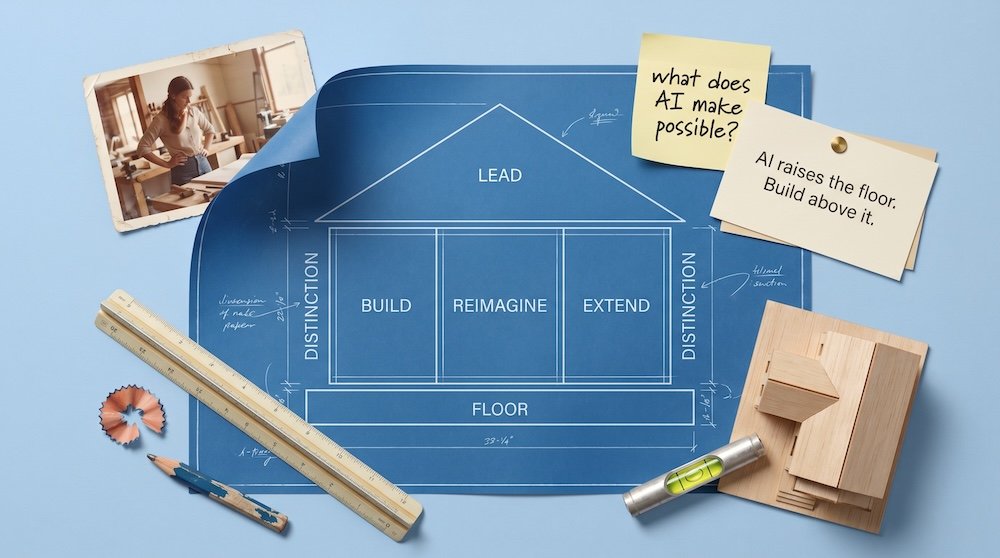
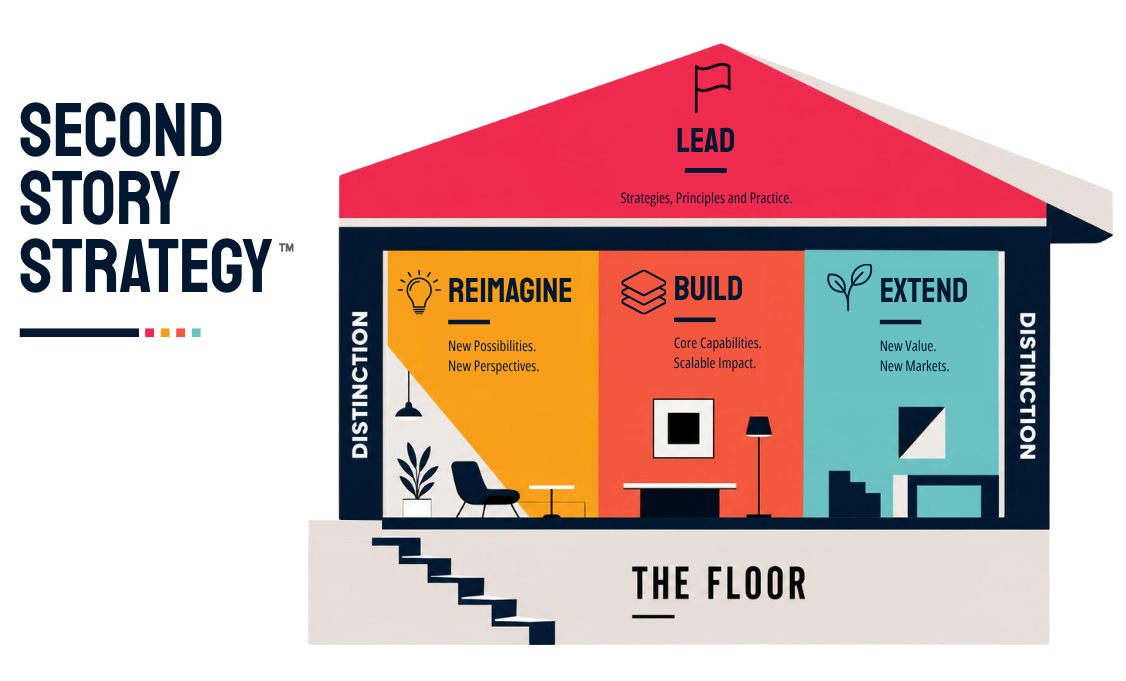
Once I’d seen the pattern in enough companies, the moves started to repeat (oh … how I do love a pattern). The standouts were working through four levels, in roughly the same order, with distinction running up through all of it like the load-bearing walls of the building. That’s the Second Story Blueprint. Here’s what each level actually involves, and a real company that shows it in action.
Worth saying plainly before we climb, the Second Story isn’t any one of these levels. It’s all four together, raised above the floor. Extend tends to get the attention because it’s the visible, exciting part, but it only stands up because of the Build work beneath it and the Lead work holding it together.
Build: People, Systems, Context
The ground everything else stands on. People who are supported and trained, systems and context that give AI something real to work with, and the three Ps that keep it all safe and consistent … principles, policies, and playbooks. It’s the least glamorous level and the one most leaders are tempted to skip, which is precisely why so many AI efforts wobble later. You can’t raise a second story on sand.
I think Moderna is a lovely example of doing this properly. Before turning everyone loose, they laid the people-and-governance groundwork first. They ran an internal contest to find their best power users and turned them into a champions network, set up office hours and an internal forum, and extended their existing compliance practices onto the platform so people could experiment without fear of breaking something. Early adoption hit 80%, and employees went on to create more than 750 custom AI assistants across legal, research, and manufacturing. Solid footing first, everything else second.
Reimagine: Automation and Enhancement
This is AI inside the work you already do. Faster, smoother, cheaper, better. Genuinely valuable, completely necessary, and the level where most companies stop … which is why so many AI initiatives plateau at “we got faster” and never become anything more.
I remember reading about Lemonade and immediately thinking it shows how far a well-executed Reimagine can go. The insurance industry has always treated claims as a slow, manual room, a human adjuster working each one, paperwork, days of waiting. Lemonade re-engineered the whole process around AI. Their claims bot reads the claim, checks the policy, runs the anti-fraud checks, and pays out, in one record case in just two seconds. Same product, same business, a completely reimagined process. (Two seconds. It takes me longer than that to find my glasses.) It’s brilliant. It’s also still a Reimagine … a faster version of something insurers already do, not a new floor above it.
Extend: New Value, New Offers
This is where the building gets its height. The new capabilities, products, services, and revenue streams that become possible once the groundwork is solid and the existing work has been reimagined. Extend is where AI stops making you cheaper and starts making you distinctive.
For me, IKEA is the clearest example I’ve come across. They started exactly where everyone starts, with a customer service chatbot, named Billie after the bookcase, now handling around 47% of customer queries. The obvious move at that point is to bank the savings and cut headcount. IKEA did something different. They looked at the questions Billie couldn’t answer and, instead of treating them as failures to fix, treated them as signals. The unanswered questions weren’t about parcels. They were about design … customers wanting help imagining their rooms. So IKEA reskilled 8,500 customer service workers into remote interior design advisors, and that new design channel generated €1.3 billion in revenue by the end of that financial year, around 3.3% of total sales. €1.3 billion. With a B. From the part of the business everyone else was busy cutting.
What I love about it is that the famous part, the billion-euro design service, was the Extend. But it only happened because the chatbot reimagined the work, and because reskilling 8,500 people instead of cutting them was the Build and Lead work that made the next move possible. Put all of it together and you have a Second Story, not a single clever feature.
Lead: Strategy, Principles, Practice
The level that holds the whole building together. Leaders who set the direction, model the behavior themselves, and keep the organization pointed at distinction instead of sliding back to the floor. This is the level that turns a few good ideas into a sustained strategy rather than a clever one-off, and it’s where the human judgment behind a good Delegation Dial really earns its keep.
When Shopify CEO Tobi Lütke made AI use a baseline expectation, what struck me was that the part that mattered wasn’t the mandate, it was that he went first himself. He talked openly about using AI all the time, used it in his own work, and made clear the expectation applied to everyone, the executive team and him included. You can debate the tone of that memo all day, and plenty have, but the leadership principle is hard to argue with, which is that you can’t ask your people to climb the stairs while you wait in the lobby.
Distinction: The Walls That Make It Yours
This is the part it’s easiest to skip past, and I’d argue it’s the one that decides everything.
You’ll notice distinction isn’t a level in the Blueprint. It’s the load-bearing walls, running up through all four. That’s deliberate. A Second Story isn’t about bolting on any new capability or chasing whatever shiny use case is making the rounds on LinkedIn this week. If you raise a generic second floor, the kind your competitors could order from the same catalog, you’ve just lifted your own ordinariness one floor higher. Congratulations, now you’re forgettable with a mezzanine.
The companies that pull ahead build on top of what they already do better than anyone else. Their unique value proposition. The thing customers already came to them for, now amplified by AI rather than averaged away by it.
This is exactly why I think IKEA’s story works and a generic version of it wouldn’t. IKEA didn’t spot a random gap and chase it. The unanswered questions pointed straight back at the thing IKEA has always been about … helping ordinary people design and furnish a home they love. The interior design service wasn’t a pivot away from who they are. It was a deeper expression of it, made possible by AI freeing up the people to deliver it. The Second Story was unmistakably an IKEA second story. Nobody else could have built quite that one.
That’s the test for every level. The Build work should rest on your context, your institutional knowledge, the things only your organization knows. The Reimagine work should sharpen the processes that make you you, not just the generic ones any business has. The Extend should grow out of your actual strengths and your customers’ actual unmet needs, not a slide deck of trendy possibilities. And the Lead work should keep asking, at every turn, the most useful question in the building, which is whether this is making us more like everyone else, or more like the best version of ourselves.
Because AI will happily help you become a faster, cheaper, slightly slicker version of your competitors. It’s remarkably good at generic. The whole point of a Second Story Strategy™ is to refuse that, and to use the same tools everyone else has to build something only you could build.
Raise a generic second floor and you’ve just lifted your own ordinariness one floor higher. The point is to build the one only you could build.
Great Craftsmanship Takes Time
The inconvenient part of all this, for everyone including me, is that it takes time.
Building a quality Second Story takes the kind of time people very rarely get inside a business. Time to experiment. Time to learn. Time to try something, watch it fall over, and try a different thing. Time to think differently, which is the slowest of all the times, because thinking differently is genuinely uncomfortable and people will choose almost any other activity over it. Including, in my experience, organizing the stationery cupboard.
Great craftsmanship has always worked this way. Cathedrals weren’t built in quarters (and arguably they’re still being built … bless the gothic stonemasons). The companies I watched climbing the stairs gave their people something most leaders are extremely reluctant to part with … space. Permission to poke at things. Permission to bring an idea that hadn’t been fully cooked yet. Permission to say “I tried that and it didn’t work, here’s what I learned” without the room going silent. Not a hackathon weekend or an innovation sprint that gets defunded after Q3 because the budget review went sideways. Actual, ongoing, protected time for the messy work of figuring out what to build.
Which means a Second Story isn’t really a software project. It’s a people project. Building a quality Second Story will require the people in your organization to be bolder than they’ve been allowed to be, brighter than their job descriptions usually let them be, and genuinely enthusiastic about what’s possible. It leans hard on the human capabilities that get more valuable as AI gets cheaper, the kind of thing I’ve written about in the 5 to Thrive. None of that shows up by accident, none of it shows up under the pressure of shipping something by Friday, and none of it shows up if “innovation” is the agenda item right after “office plant rota.”
If you want to know whether your organization has the conditions for a Second Story Strategy™, this is the bit to inspect. Not the tech stack. The room you’ve made for your people to think.
A Second Story isn’t really a software project. It’s a people project. Bolder, brighter, more enthusiastic people, with the time to actually build something worth building.
The Question That Changes Everything
If you want a quick test for where your organization sits right now, listen to the question being asked in the room.
How do we use AI? is an adoption question. It assumes the existing business and asks how to plug AI into it. Important, and absolutely a place to start.
What does AI now make possible that wasn’t possible before? is a strategic question. It assumes the floor is rising, the tools are available to everyone, and your competitive position depends on what you can build that the floor alone can’t deliver.
Both questions matter. Companies need both. But a Second Story Strategy™ lives almost entirely in the second one, and that’s the question most organizations I’ve worked with hadn’t yet given themselves permission to ask. (Permission, it turns out, is the missing ingredient in a lot of strategy meetings.)
Which brings us back to Klarna.
Remember that triumphant 2024 announcement, the 700 agents’ worth of work, the $40 million? By 2025, the story had a second chapter. Customer satisfaction had dropped, the AI couldn’t hold the complex and emotional cases, and Klarna began hiring human agents back. The CEO who’d been AI’s loudest champion admitted the company had “overestimated AI’s capabilities and underappreciated the human aspects of service delivery.” Same starting move as IKEA, near enough. A chatbot handling customer service. The difference is that Klarna treated the floor as the destination. They reimagined the room and stopped there. No Build work underneath, no Lead holding it together, and so no way to reach Extend. One level out of four isn’t a Second Story, it’s just a faster floor. And when that floor turned out to be shakier than the press release suggested, there was nothing built around it to hold it up.
No villains here, to be clear. Klarna made a clear bet, learned something expensive, and is course-correcting in public, which takes some nerve. But the contrast is the whole point. IKEA asked what is this telling us we should build next? Klarna asked how much can we cut? Two perfectly reasonable questions. One builds a Second Story. The other leaves you standing on a floor, hoping it holds.
You don’t need to be IKEA-sized to ask the better question. You don’t need an enterprise AI budget. You don’t even need a particularly impressive job title. What you need is the willingness to stop treating AI as something you bolt onto your existing business and start treating it as the foundation for the next version of your business. And you need to give the people inside the building enough time, room, and trust to do the building.
The companies thriving in this new landscape aren’t keeping pace. They’re climbing the stairs. The floor will keep rising under all of us. The only real question is what you decide to build on it.
Frequently Asked Questions
What is a Second Story Strategy™?
A Second Story Strategy™ is the deliberate plan for what your organization builds on top of AI capability … the distinct value, new offers, and competitive position that AI alone can’t deliver, but that AI now makes possible.
It treats AI as the foundation for the next version of the business, not just a tool to make the existing business faster. It assumes that everyone in your market has access to the same AI capability, and asks what you will build above that shared floor to remain distinctive, valuable, and competitive.
How is a Second Story Strategy™ different from an AI strategy?
Most documents labeled “AI strategy” are really AI adoption plans. They focus on which tools to use, which processes to automate, and which teams to train. A Second Story Strategy™ goes further by defining what new value, offers, and competitive position your organization will build because of AI.
The difference is the question being asked. An AI adoption plan asks how do we use AI? A Second Story Strategy™ asks what does AI now make possible that wasn’t possible before? The first leads to faster sameness. The second leads to genuine differentiation, and very often to new revenue streams that didn’t exist before AI made them visible.
What is the Second Story Blueprint?
The Second Story Blueprint is the architecture behind a Second Story Strategy™. It has four elements, which are Build (people, systems, context, and the three Ps of principles, policies, and playbooks), Reimagine (automation and enhancement), Extend (new value and new offers), and Lead (strategy, principles, practice). Plus, distinction which runs up through every level like the load-bearing walls.
The whole structure together is the Second Story, not any single level. Most organizations get stuck between Reimagine and Extend … they’re using AI inside their existing work but haven’t yet built anything new on top of it. The Blueprint is the map for moving deliberately from one level to the next, rather than getting stuck at the floor.
How do I know if my company has a Second Story Strategy™?
Listen to the questions being asked in your strategy conversations. If the dominant question is how do we use AI more, you have an AI adoption plan, which is a valid starting point. If the dominant question is what should we build that AI now makes possible, you have the beginnings of a Second Story Strategy™.
The other signal is what AI is producing in your business. If AI is making you faster at the work you already do, you’re working on the floor, and that’s a perfectly good place to start. If AI is making your organization capable of work it couldn’t deliver before, surfacing demand it couldn’t previously see, or creating offers that didn’t exist before, you’re starting to build a Second Story.