Where Your Organization Actually Stands on AI
I’m building a slide for a keynote this week, and Klarna is on it. It has two numbers, side by side. In early 2024, the company’s AI customer service assistant handled 2.3 million conversations in a single month, doing the work of 700 agents and dropping resolution times from eleven minutes to under two. By 2025, the CEO was publicly admitting that quality had slipped and the company was rebuilding human capacity for the harder cases.
What I keep coming back to as I prep this talk is that the same company, with the same AI, made very different decisions eighteen months apart, and the difference between those decisions wasn’t really about the technology. Klarna didn’t fail at AI, they just confused two very different levels of AI maturity for the same thing, and many organizations I work are doing some version of the same.
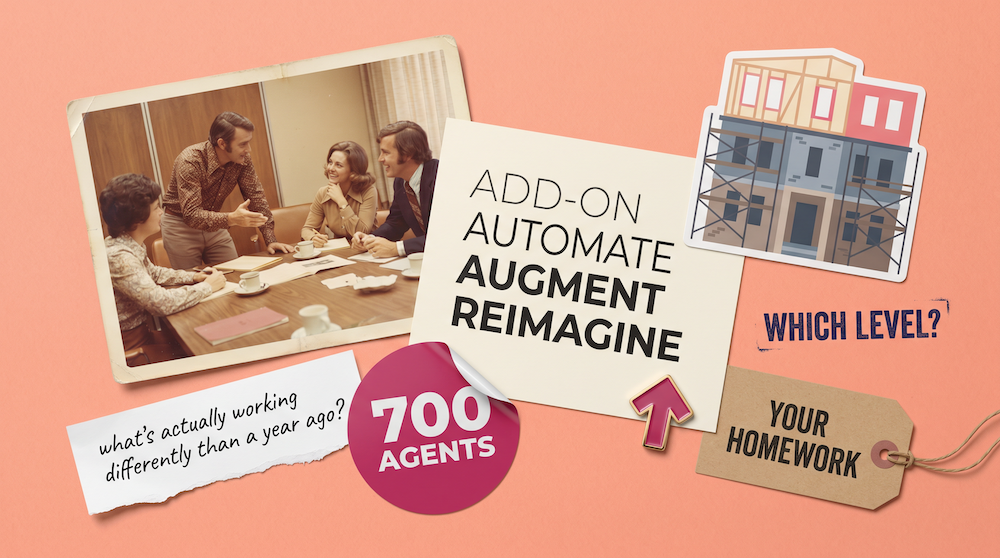
So let me share the map I’ve been using to sort it out. There are four levels of AI maturity that I’ve seen. The four levels are Add-On (people use AI for parts of things), Automate (do the same things faster), Augment (do existing things better), and Reimagine (do new things in new ways). Most organizations are sitting at Add-On right now, which is genuinely fine because it’s where almost every climb starts. A meaningful number have made it to Automate, fewer still are properly Augmenting, and almost no one is Reimagining yet. That’s actually good news, because seeing the four levels clearly is the first move worth making, and it’s a move available to every organization.
Let me walk you through what each level looks like, and how to honestly diagnose where you are. (It’s uncomfortable in a useful way, kind of like flossing … lol!)
Many organizations (most, probably) don’t yet have a true AI strategy. They have an AI vendor list pretending to be one.
Last week I wrote about why context is the moat your competitors can’t buy, and the homework was to start building yours. This post is the next layer up, because once you have the context, the question becomes what you’re actually building with it. Fair warning, there may be some light squirming as you read this, mine included, and I’ll go first.
Level 1: Add-On (Where Almost Everyone Starts)
Add-On is when AI is in the room but hasn’t really joined the team. Some people have access to ChatGPT, some of them use it, and most use it for parts of things, mostly when they remember to. The rest of the work is exactly what it was before.
A few signs you might be at Add-On:
- AI use is unevenly distributed, depending on who finds it interesting
- It’s hard to describe, in concrete terms, what AI has actually changed about how the work gets done
- “We have AI” mostly means “we pay for ChatGPT licenses”
- The most reliable AI users in the organization are also the people who would have been early adopters of any new tool
If that sounds like you, you’re in great company, because this is where the vast majority of organizations are right now, which is exactly why naming it matters. Add-On is a perfectly reasonable starting point, and the climb out is mostly about choosing to deploy AI deliberately rather than accidentally, which is a much more achievable next step than it sounds.
Add-On is what happens when you buy AI. The other levels are what happens when you actually use it together.
Level 2: Automate (Do the Same Things Faster)
Automate is the first proper level. You take a task you already do, you point AI at it, and you do it faster, across the team, deliberately, with consistent results.
A few examples:
- Drafting first-pass emails (the inbox kind, not the existential kind)
- Summarizing meetings you didn’t attend (or did attend and have already mentally blocked out)
- Cleaning up CRM notes that read like a hostage letter
The value here is real, because the team gets time back, the obvious busywork shrinks, and people start to feel what it’s like to have AI as a working partner. McKinsey’s 2025 State of AI report shows 88% of organizations now use AI in at least one business function, up from 78% the year before. In other words, almost everyone with a real AI program is automating something, somewhere.
The catch with Automate is that it’s exactly where the floor is rising. When everyone in your industry has the same tools and the same “we saved 30% of email time” wins, the speed advantage becomes table stakes pretty quickly. Automate is genuinely necessary, it’s just not enough on its own.
Quick test: if you switched off your AI tools tomorrow, would the team be slower, or would the work itself fall apart? If they’d just be slower, you’re at Automate, which means the AI is sitting on top of how you work rather than changing how the work happens.
Level 3: Augment (Do Existing Things Better)
Augment is where the real money lives, and where the climb starts to feel genuinely worth it. You stop asking “how do I make this task faster?” and start asking “how do I make this work measurably better than it was before?”
Augment uses AI not to replace the human contribution but to elevate it. From the outside, the work looks similar, but the quality, the consistency, and the depth are dramatically different.
In a past life, I was a director of product strategy. My job was to connect technology and people, which almost always meant getting an organization to do something in a new way. Because, honestly, why buy a new system if you just want the same thing you had? The whole point was always to stretch the work, not just shuffle it. What’s different about doing that with AI today is that most companies don’t have a team of consultants riding in to guide them through it, especially the small and mid-sized ones. They look to their IT team and more or less forget that IT is also new to AI, and AI is a very different game from rolling out a CRM or configuring a new Microsoft user. So the default becomes what we all know. Status meetings. So many PowerPoint decks. The rocket-on-the-rocket-deck level of decks. And six months later, the work looks much like it did before, just with ChatGPT in the corner. None of that is anyone’s fault, it’s just what happens when there’s no map.
Which brings us back to Klarna. The early numbers I opened with were genuinely impressive, and they made every leadership team I worked with start asking some version of “could we do that?” The honest answer was yes, but with a catch the headlines didn’t mention. The AI was handling the volume beautifully but couldn’t navigate the nuance, the emotional context, the genuinely complex problem that didn’t fit a known pattern. By 2025, Klarna’s CEO acknowledged the quality drop, and the company started rebuilding human capacity for the conversations that needed it. Today, Klarna runs a hybrid model where AI handles the routine, high-volume work and humans own the conversations that need actual judgment, empathy, or context. The AI still does the work of hundreds of agents, the humans handle what AI can’t, and together the system is better than either alone.
That’s Augment, properly done. AI makes the human contribution more valuable than it could be on its own, and humans make the AI contribution genuinely useful instead of just impressive on a slide.
The McKinsey data backs this up at scale, with only about 21% of organizations having fundamentally rebuilt even some of their workflows around AI. The ones who do, though, are nearly 3x more likely to be among the AI high performers actually capturing meaningful business value. (That group is about 6% of all respondents, which means there’s a lot of room at the top.)
If you’re moving from Automate into Augment, you’re starting to do the work that compounds. Press on.
Automate makes you faster. Augment makes you better. And better is where the climb starts to pay off.
Level 4: Reimagine (Do New Things in New Ways)
Reimagine is the hardest of the four levels and the one almost nobody is doing yet, which is partly why it’s such a good place to be heading.
Reimagine doesn’t ask “how do we do this work better?”, it asks “should this work even exist, and what new work is now possible that wasn’t before?” It’s where products, services, and customer experiences get invented that simply could not have existed two years ago, and where the question stops being “where can we save time?” and becomes “what can we now offer that no one else can?”
PwC’s 2026 AI Performance Study found that the leading companies on AI performance are 2.6 times more likely than their peers to use AI to reinvent their business model rather than just to optimize existing workflows. The patterns showing up at this level look like this:
- Manufacturers shifting from selling machinery to selling AI-powered predictive maintenance as a recurring service, turning a one-time sale into a long-term relationship (hello John Deere … we’re talking about you!)
- Professional services firms moving from billable hours to subscription access to AI-augmented advisors, with humans stepping in for the high-stakes decisions
- Retailers building AI-tailored subscription models that adapt over time to each customer, instead of running the same promotion at everyone
- A company creating new services (and serious amounts of new revenue) based on what they learned from earlier levels like Ikea has done.
These aren’t faster versions of old work, they’re entirely new offers, made possible because AI is finally part of the value proposition itself rather than a tool sitting next to it.
This is also where last week’s piece comes back in, because none of these reimagine moves work without strong context underneath them. You can’t sell an AI-powered advisor service if you haven’t captured what your senior advisors actually know. Reimagine sits on top of Augment, and Augment sits on top of context. The good news is that climb is doable, and the better news is that almost nobody is doing it yet.
Reimagination happens when you use the technology of AI to be more human where it matters most.
How to Diagnose Where You Are
Try this with your leadership team this week. It takes ten minutes.
For your three biggest “AI wins” of the past year, ask:
- Is AI being used by parts of the team for parts of things, or is it deliberately deployed across the work?
- Did this make existing work faster, or did it change the quality of the work itself?
- If we removed AI tomorrow, would the workflow still make sense, or has the work itself been rebuilt around AI?
- Are we offering anything to customers we genuinely couldn’t have offered before AI existed?
If your answers don’t get past question one, you’re at Add-On, which is exactly where most organizations are. The next step is deliberate deployment, which means picking a workflow, deploying AI across the team consistently, and measuring the result.
If your answers cluster around question two, you’re at Automate, which is a real win and worth celebrating, and also a moment to start asking the harder Augment questions about what the work could become if you let it.
If your answers stretch into question three, you’re starting to Augment, which puts you in the small but mighty group of organizations actually capturing meaningful AI value. Keep going.
If you can answer “yes” to question four with a straight face, you’re Reimagining, which means you’re rare, you’re early, and you’re doing the thing the rest of the market hasn’t even named yet.
If you want a more structured version of this diagnostic, I built one. The AI Alignment Check walks you through where your organization actually stands across the levels in about ten minutes, with no judgement, and it’s illuminating in the same way a good dentist appointment is illuminating. (You knew. You just didn’t want to know yet.)
• • •
The Map Tells You Where You Are. Strategy Tells You What to Build.
The AI Maturity Map answers one question, which is where do you actually stand, and that’s a useful question even if it’s not the only one.
The harder, more interesting question is what you do next. The Map gives you the diagnosis, and Second Story Strategy is what you build with it. Yes, it’s about competitive advantage and standing out, but an equally big part of the work is just being the best version of yourselves as an organization. Doing the same things faster is genuinely useful, but focusing only on that is how you miss the new ideas, the stretch, the new markets, the work you didn’t know you could do. Anyone can be faster. The leaders who use AI to build their second story are the ones still standing on top of the climb in five years.
Your homework this week: pick one workflow, just one, and instead of asking “how can AI make this faster?”, ask “how could this work be measurably better, or genuinely different, if I rebuilt it with AI as a real participant?” That single question, asked seriously, is how the climb actually starts.
AI isn’t the strategy. The strategy is what you build because of it.
Frequently Asked Questions
What is the AI Maturity Map?
The AI Maturity Map is a four-level framework for diagnosing how an organization is actually using AI. The four levels are Add-On (people use AI for parts of things), Automate (do the same things faster), Augment (do existing things better), and Reimagine (do new things in new ways).
Most organizations cluster at Add-On and mistake it for an AI strategy. A meaningful few have made it to Automate. Fewer still are genuinely Augmenting. Almost no one is Reimagining yet. The Map gives leadership teams a shared, honest vocabulary for talking about what their AI program is actually achieving, instead of what the slide deck claims it is.
What are the four levels of AI maturity?
The four levels of AI maturity are Add-On, Automate, Augment, and Reimagine. Add-On is when AI is being used for parts of work by some of the team, with no consistent deployment. Automate is when AI is used to do the same work faster across the team. Augment is when AI is used to do existing work measurably better. Reimagine is when AI enables new offers, services, or business models that wouldn’t have been possible before.
The honest test of which level you’re at is what would happen if AI disappeared tomorrow. At Add-On, almost nothing changes. At Automate, the work is slower. At Augment, the work loses its quality edge. At Reimagine, entire offerings stop existing.
What is the difference between Automate and Augment?
Automate uses AI to do the same work faster without changing the work itself. Augment uses AI to make the work measurably better, deeper, more consistent, or more personalized than it was before. The output looks similar in both cases. The quality is dramatically different.
A useful test: if you removed AI from the workflow, would your team be slower, or would the quality of the work drop? If only the speed changes, you’re at Automate. If the quality changes, you’ve moved into Augment.
Is it bad to be at the Add-On level?
No. Add-On is a legitimate starting point and most organizations are there. The problem isn’t being at Add-On, the problem is staying there while believing you’re somewhere else.
The difference between Add-On and Automate is mostly deliberate deployment, not new technology. Pick the work that genuinely benefits from AI, deploy it consistently across the team, and measure the result. That’s the climb out of Add-On.
What does it actually take to reach Reimagine?
Reimagining requires three things most organizations don’t yet have. Leadership willing to question the current business model, not just the current workflows. A clear understanding of where AI changes what’s possible, not just what’s faster. And a tolerance for building offers that didn’t exist before, which means tolerating real uncertainty about how customers will respond.
The good news is you don’t have to reimagine everything at once. You only need to reimagine one thing your competitors will struggle to copy. That’s where lasting competitive advantage starts.
How does the AI Maturity Map connect to Second Story Strategy?
The AI Maturity Map is a diagnostic. It tells you where your organization actually stands across the four levels of AI use. Second Story Strategy is what you do once you have that diagnosis. It’s how you build something on top of a rising floor instead of just standing on it with everyone else.
Most organizations need to do both. Diagnose honestly. Build deliberately. The Map without the Strategy gives you clarity but no direction. The Strategy without the Map gives you direction but no honest starting point.