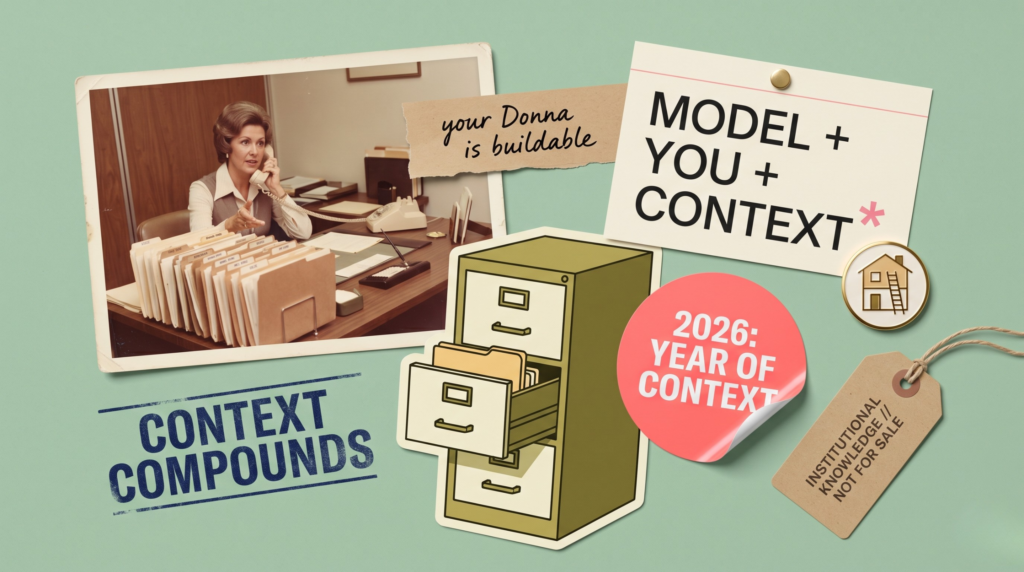
Your Donna Is Buildable. Most Companies Are Leaving Her in a Filing Cabinet.
I started teaching AI everything about me.
Thirty keynote transcripts. Podcast recordings. Three books. Old proposals, blog archives, workshop outlines, hot takes I’ve posted on LinkedIn when I probably should have been sleeping. All of it, fed into Claude, chunked and organized into a markdown wiki, visualized in Obsidian, connected to a GitHub repository. (The new nerd secret handshake, by the way, is seeing who lights up when you say “Obsidian and GitHub” in the same sentence. If you just did, hi.)
I’m still not done. I’m adding who’s on my team, who we serve, how I actually make decisions, the difference between things I’ll say on stage and things I’ll only say in private to clients. Why on earth would anyone put this much effort into teaching AI about themselves?
Because I want a Donna.
If you’ve ever watched Suits, you know Donna. She’s the assistant who somehow knows everything about everyone. She anticipates. She reads the room before anyone else walks into it. She makes Harvey look brilliant because she’s already three steps ahead of whatever mess is about to land on his desk. That’s what a well-built context does for AI. It stops being a generic helper and starts being the person who has been working alongside you for years.
And it’s already paying off in ways I didn’t expect. Claude has started pushing back on me. When I’ve tried to revisit topics I closed months ago, it’s reminded me that I closed them. When I’ve started building what felt like a new framework, it’s surfaced the three I already built that say almost the same thing (because, if I’m honest, I create frameworks the way some people create spreadsheets … prolifically, and with occasional duplication). Good context doesn’t just help AI serve me. It sometimes saves me from myself.
Your Donna is buildable. Most companies are just leaving her in a filing cabinet.
Models change every week. Context compounds.
Same AI. Wildly different results.
Two companies can buy the exact same AI tools, write the exact same prompts, and get wildly different output. One sounds like a generic consultant was paid too much to write something nobody will read. The other sounds like it’s been working in that industry, at that company, for years. The model is identical. The difference is context.
Your AI results depend on three ingredients.
Model
What it knows and how it thinks.
You
What you ask and how you ask it.
Context
What it’s been told and how it’s been trained.
All three matter. Swap the wrong model in and good context can’t save you. Write a vague prompt and the best context in the world won’t compensate. Miss the context and you get the same generic output your competitors are getting.
So why am I calling 2026 the year of context? Because it’s the ingredient most organizations are underinvesting in right now, and it’s the only one that compounds. Context is portable … a well-built library works across ChatGPT, Claude, Gemini, and whatever ships next quarter. It’s movable. You can load it into a new team member’s AI setup, into an agent, into a workflow. Same library, many applications. It’s the consistency engine that stops your team, your agents, and your automations from all freelancing in different directions.
And it’s the ingredient your competitors can’t buy. They can buy the model. They can hire someone who knows how to prompt. They cannot buy twenty years of your client notes, your playbooks, your products, or the specific way your best people think.
Personal context: building your Donna starter kit
Personal context is what makes AI sound like you instead of like a LinkedIn post generator that’s had too much coffee. It’s the difference between “write me a post about leadership” producing something you’d be embarrassed to share, and the same prompt producing something that sounds genuinely like you, because the AI actually knows who you are.
Here’s what personal context looks like, broken into six buckets.
Who you are
Your bio, your role, your credentials, what you do and who you serve, your point of view, your hot takes, the things you always say and the things you never say.
How you sound
Your tone of voice, your sentence rhythm, your banned phrases (I have a list, and “unlock” is at the top of it), writing samples that represent you at your best, style guides for different formats because your keynote voice and your email voice should not be identical.
What you know
Your signature methods, your products, your services, your offers, the way you do things, your past work (transcripts, articles, talks, books), your clients, your audiences, your use cases.
How you decide
Your values, your principles, your non-negotiables, how you evaluate opportunities and vendors and hires, what a “good” outcome actually looks like for you.
Who you work with
Your team members and what each of them owns, your partners and vendors, your regular collaborators, the people you rely on for specific kinds of work. AI can’t help you route a request to the right person if it doesn’t know who the right person is.
Tools you use (and why)
The platforms you run your business on, the tools you’ve chosen and the ones you’ve rejected, and, most importantly, why. The “why” matters because it tells AI how you make choices, not just what you’ve chosen.
A quick nerd note. I’m building mine as markdown files, which is just nerd speak for a text document that AI reads particularly well. You absolutely do not need to do that. A Word doc works. A Google Doc works. Markdown is smaller and AI processes it cleanly, so it’s a bonus if you’re comfortable with it, but the format is not the point. Getting the content out of your head is the point.
Once it exists, the 20-60-20 still applies, but your first 20% takes dramatically less effort because the context is already doing most of the heavy lifting. AI stops sounding generic. It starts writing in your voice, referencing the way you actually do business, and routing requests to the right people. And, in my experience, the best sign that context is actually working is when AI starts pushing back on you … reminding you of decisions you already made, surfacing work you’d forgotten, stopping you from doing something you told it last month you’d stopped doing.
Organizational context: the moat your competitors can’t buy
Personal context makes you better. Organizational context makes your company uncopyable. This is where the real strategic play lives … and, to be honest, where most of the work actually is.
Here’s what organizational context includes.
- Your data (and brace yourself, because this is where the cleanup lives). Customer records, deal histories, service logs, conversation archives, product data, pricing history, performance metrics. Dirty data in means dirty context out. Whoever has been dumping records into the CRM for ten years with no discipline is about to find out.
- Your knowledge. Playbooks, SOPs, internal documentation, product and service details, brand voice guidelines, style guides, legal guardrails, “how we do things here” documents. Most organizations don’t have those written down anywhere. It all lives in three people’s heads and, worryingly, two of them are thinking about retirement.
- Your decision structures. How you evaluate a deal or a hire or a partnership. Who owns what, who approves what, how things escalate. The undocumented rules everyone follows but nobody teaches. (If you’ve ever watched a new hire get gently corrected in their third meeting for something nobody ever told them, you know exactly what I mean.)
- Your institutional memory. The stuff in your best people’s heads. The client stories, the war stories, the lessons from things that went sideways in 2019 that nobody wants to repeat. The context that walks out of the door every time someone quits.
Now for the part nobody wants to hear. Much of this work is cleanup, not creation. Most organizations discover, roughly fifteen minutes into their first context project, that the CRM is a disaster, the processes were never documented, the style guide was last updated when Obama was president, and three different people own “brand voice” and fundamentally disagree about what it is.
That’s not a reason to avoid context work. That’s the reason to do it. Because whoever cleans up first wins.
Gartner predicts that through 2026, organizations will abandon 60% of AI projects unsupported by AI-ready data. Sixty percent. Most of those projects didn’t fail because the AI wasn’t smart enough. They failed because the context was a mess and nobody wanted to deal with it.
And it gets worse. According to IDC research, less than 1% of enterprise unstructured data is actually suitable for AI consumption in its current state. One percent. Your company has been collecting documents, emails, transcripts, and records for years, and the overwhelming majority of it isn’t in a state where AI can use it yet. That’s not a failure. That’s an opportunity, and a very specific one.
Your competitors can buy the same model. They cannot buy twenty years of your client notes, your playbooks, and the way your best people think.
Why this matters for AI agents (and why most agents will flop without it)
The conversation about AI agents has mostly been about what they can do. The more useful question is what they’ll do consistently. An agent that acts brilliantly in interactions one through forty-six and then goes completely off-script in interaction forty-seven is not an agent your customers want meeting them. It’s a liability in a nice suit.
Context is the thing that holds the line. When an agent is pulling from the same library of principles, tone, playbooks, and decision rules that your best humans use, it stays on-brand and on-message across hundreds of interactions. Without that? It’s improvising. And improvising AI is precisely the kind of AI that ends up in screenshots.
This is the second story being built directly on the rising floor. Everyone has access to the floor. Everyone has the models. The second story is made of context … your specific knowledge, your specific voice, your specific way of doing things, organized and ready to be used by both humans and AI.
The company that wins 2026 is not the one with the fanciest AI. It’s the one with the best-organized knowledge.
Your homework
Three things, in order of how much resistance you’re going to feel about them.
1. Start your personal context this week
Not finish. Start. This is not a five-minute job and I’d be lying if I said otherwise. Pick one bucket from the six above (bio and who you serve is the easiest entry point), spend thirty minutes on it, save the file, and come back to it next week.
2. Pick one organizational context project and scope it honestly
Is it a create job, a cleanup job, or both? (Spoiler: it’s both.) Don’t try to boil the ocean. One area. One honest scope. Then go.
3. Appoint a context owner
This role doesn’t really exist in most organizations yet, and it is not an IT job. It touches every function … sales, service, marketing, operations, leadership … and it needs someone with strategic authority, not just technical skills. This is one of the most important hires or internal moves you’ll make in the next eighteen months, and most companies won’t make it until they’ve already been passed by someone who did.
The good news is that this is doable, and it compounds. The work is not glamorous. It is also not finished in a weekend for most people, and anyone who tells you different is selling something. But every hour you invest in context pays off every time you or your team touches AI from that moment on. Models will keep changing. Context keeps compounding.
If your company is pouring money into AI tools without pouring equal energy into context, the gap between what you’re spending and what you’re getting is about to become impossible to ignore. If that sounds like a conversation worth having, drop me a note.
(Oh, and if you liked this article? Thank Claude. It recommended I write it, based on my context.)
Frequently Asked Questions
What is the AI context economy?
The AI context economy is the competitive shift where organizations that capture, curate, and organize their institutional knowledge gain an AI advantage competitors can’t replicate. While the underlying AI models are largely the same for everyone, the context an organization feeds into those models (customer data, playbooks, product details, brand voice, decision rules) becomes a unique, defensible asset.
The companies winning in the context economy are the ones treating their institutional knowledge as a strategic asset, not a filing problem. They’re investing in cleanup, curation, and governance now so their AI outputs stay consistent, on-brand, and specific to their business.
What’s the difference between personal and organizational AI context?
Personal AI context is the information that helps AI produce output that sounds like a specific individual: your bio, tone of voice, writing samples, the way you work, and your decision-making style. Organizational AI context is the information that helps AI produce output aligned with a company’s specific knowledge, processes, and identity: customer data, playbooks, brand guidelines, and institutional memory.
Personal context is usually faster to build because one person owns it. Organizational context takes longer because it requires pulling knowledge out of multiple people, systems, and documents, and it usually surfaces a lot of cleanup work along the way.
What is an AI context file?
An AI context file is a document, or set of documents, that gives AI the background information it needs to respond in a way that’s specific to you, your role, or your organization. It can include anything from a bio and tone of voice guide to playbooks, brand guidelines, client information, team details, or the tools you use.
Context files can be built in almost any text format. Markdown files are often preferred for technical users because they’re lightweight and AI tools process them cleanly, but a Word doc, Google Doc, or even a shared knowledge base works. The format matters far less than the content.
Why does AI produce generic output?
AI produces generic output when it doesn’t have enough context about who you are, what you do, or how you want the response to sound. Without context, AI defaults to the most common, middle-of-the-road version of whatever you asked for, which is why so much AI-generated content sounds like it was written by a committee.
The fix isn’t a better prompt, it’s better context. Give AI your specific background, voice, products, and examples of good work, and the same prompt will produce dramatically more personalized output.
How do I start building AI context for my business?
Start by picking one area with clear boundaries: your personal brand, one customer-facing team, or one specific use case. Gather the foundational documents (bios, brand voice, playbooks, customer data, product details) and review them honestly for quality and accuracy before loading them in.
Expect to find gaps and cleanup work along the way. Most companies discover their processes were never documented, their CRM data is messy, or their style guide is out of date. That cleanup is the work. The organizations that do it first build a durable AI advantage.
Is building AI context worth the time investment?
Yes, because context compounds. Every hour you invest in building good context pays off every time you or your team uses AI from that point forward, across any model or tool. Unlike prompts, which have to be rewritten each time, context is reusable, portable, and keeps working as AI improves.
It’s also one of the few AI investments that can’t be commoditized. Competitors can buy the same AI tools you’re buying, but they can’t buy your institutional knowledge. That’s the moat.
Who should own AI context inside an organization?
AI context is not an IT job. It’s a strategic role that touches every function, so it needs to sit with someone who has cross-functional authority and business perspective. Some organizations are creating dedicated roles (Head of AI Context, Knowledge Architect, or similar). Others are assigning it to leaders in operations, marketing, or transformation.
The worst outcome is leaving it unowned. When nobody owns context, nobody builds it, and the AI advantage goes to the competitor who figured out the org chart first.
What’s the difference between context and prompting?
Prompting is what you ask AI to do in the moment. Context is everything AI knows about you, your business, and your goals before you ask. Prompting lives in the specific interaction. Context lives across all of them.
Good context reduces how much prompting work you have to do. Instead of explaining who you are, what you sell, and how you sound every single time, you set that up once in context and then focus your prompts on the actual task. Context is also what makes AI consistent across multiple users, tools, and agents.
Can competitors copy my AI context?
They can copy the idea of building context. They can’t copy the content. Your organizational context, your client history, your internal playbooks, your institutional memory, and the specific way your people make decisions, is genuinely proprietary and built over years of doing the actual work.
This is why context, not AI tools, is where durable competitive advantage is being built right now. Tools are the floor. Context is how you build the second story on top of it.
Does AI context replace prompt engineering?
No, it augments it. Even with excellent context, you still need to ask AI the right questions in the right way to get the best results. What good context does is reduce the amount of work each individual prompt has to do. Instead of using half your prompt to establish background, you can use all of it to focus on the actual task.
For most business users, the shift from prompt-heavy to context-heavy AI use is the single biggest productivity jump available, and it’s one competitors who haven’t made it yet won’t be able to catch up on quickly.