When Someone on Your Team Has Outsourced Their Thinking to AI
I was speaking at an association event this week, and the very first person who came up to me afterwards asked a question I want every leader reading this to see if this story sounds familiar. It’s happening more and more so I wanted to share a bit of what I said to her and offer more suggestions than I could give in the room with a line of people waiting to chat.
The conversation was with a business leader who has a senior HR leader on her team who has gone all in on AI but not in the right way. The work looks polished. The recommendations sound strategic. The personnel responses go out fast. But when anyone, including the person asking me the question, follows up with “walk me through how you got there,” the answer is a vague gesture in the direction of ChatGPT and not much else. The strategy can’t be defended. The recommendation can’t be extended. The personnel reply, the one going to a real human about a real situation, was drafted by AI and sent without much human in the middle.
Her question, almost word for word: Is it possible to bring someone back from this? And what do I do if it isn’t?
That is the question, isn’t it?
The reframe before the strategies
I want to say this up front, and then I’ll never say it again. (I have opinions about that phrase, but I’ll spare you for now.) What’s happening with this HR leader isn’t really an AI problem. It’s an accountability problem that AI made visible.
People who can’t explain their thinking didn’t suddenly lose the ability to think when ChatGPT showed up. They were probably already coasting, hiding, or under-equipped, and AI just gave them a much more efficient way to do it. Polished output. No effort. No exposure.
The reason this matters is because you’ll handle it badly if you treat it as a technology issue. You’ll write a memo about responsible AI use, run a training, feel productive, and the underlying behavior will not budge. The person who couldn’t explain their strategy before will still not be able to explain it after, they’ll just use AI more carefully so you can’t catch them at it.
And the fact that this is showing up in HR, of all functions, isn’t a coincidence. HR is the canary (referencing, of course, the canary in the coal mine scenario). When the function whose entire job is human judgment, context, and care starts outsourcing the human judgment, context, and care to a language model, you’re seeing something worth being aware of and digging into. Because if it can happen in HR, it can happen anywhere humans are supposed to be the value.
When the function whose entire job is human judgment outsources the human judgment, you’ve found the canary.
What overreliance actually looks like
The signal isn’t volume of AI use. Plenty of people use AI heavily and produce excellent work, because they bring real expertise and context to the front end and real judgment to the back end. (This is what the 20-60-20 collaboration model is built around, and we’ll come back to it.)
The signal is what happens when you ask a follow-up question. The work sounds polished, but it goes thin the moment you press on it. The person can’t tell you why they recommended one thing over another. They can’t extend the thinking into a slightly different scenario. They can’t translate the output into the specifics of your organization, because they didn’t bring the specifics to the work in the first place.
What’s missing isn’t the middle 60% where AI actually does the generating. What’s missing is both 20%s. The strategic framing at the front, where the human decides what good looks like and what the AI should be working toward. And the editorial judgment at the end, where the human owns the output, makes it specific, and stands behind it. Without those, you don’t have human-AI collaboration. You have ventriloquism.
So, can you bring someone back?
Sometimes yes. Sometimes no. And the only way to know is to do the work to find out. Here are the four moves I’d run, in order.
1. Diagnose before you intervene
What looks like overreliance can actually be three different things, and they call for different responses.
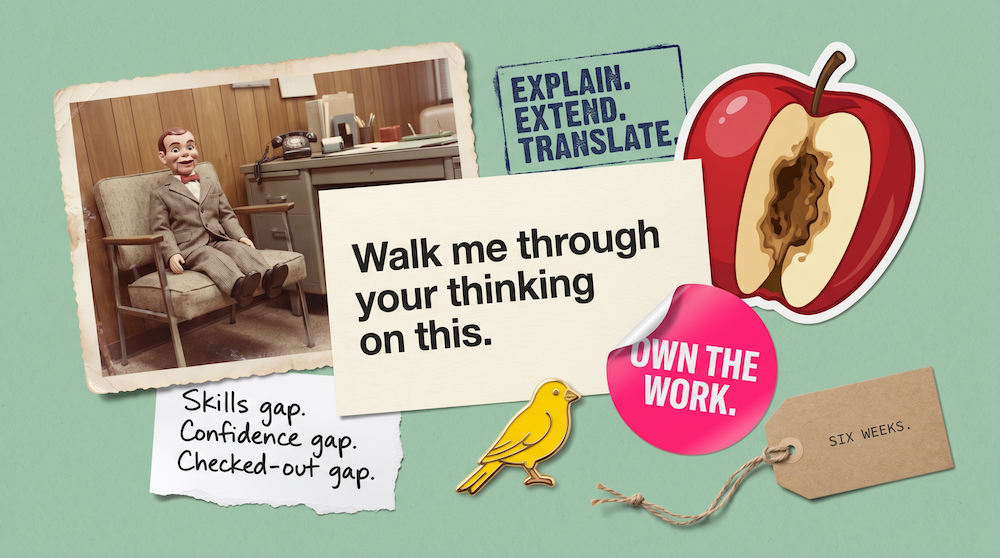
It might be a skills gap, where the person genuinely doesn’t know how to use AI well. They’ve defaulted to the easy pattern of “type a request, paste the output” because no one taught them anything different. This is the most fixable version. Shared language and a bit of practice usually closes the gap.
It might be a confidence gap, where the person is hiding behind AI because they don’t trust their own judgment. The AI gives them cover. “It’s not just my opinion, the AI suggested this.” This one is fixable too, but it takes longer because you’re rebuilding the muscle, not just teaching the technique.
Or it might be a checked-out gap, where the person was already coasting and AI is the new way to coast. This is the version that doesn’t usually fix itself, no matter how much shared language and training you provide. (You’ll know which one this is by month two.)
The diagnostic tool is simple, and it’s the same conversation in all three cases: “Walk me through your thinking on this. Why this recommendation, not a different one? What did you weigh? What’s the part you’re least sure about?” Their answer tells you which version you’re dealing with.
2. Build the bridge back with shared language
Once you’ve diagnosed, the bridge back for the first two versions is built on shared language about how humans and AI are supposed to work together on your team.
This is where the 20-60-20 collaboration model earns its keep. The first 20% is the human bringing strategy, context, and intent. The middle 60% is AI doing the generating, drafting, or analyzing. The final 20% is the human owning the output, refining it, and making it specific to your organization. When that’s the standard, “I asked ChatGPT and here’s what it said” stops being an acceptable answer in a meeting.
Pair that with the Delegation Dial, which is the conversation about which work AI should lead and which work humans must lead. Personnel inquiries, by the way, are often a hard left on that dial. The whole point of HR responding to a personnel inquiry is the human judgment, the care, the context. AI-drafting that response without serious human ownership of the final product isn’t a productivity win, it’s a quality failure with a fast turnaround time.
The reason to set this up as a team norm rather than a one-on-one correction is that it gives the person a way back that isn’t humiliating. They’re not being singled out. The whole team is being held to the same standard.
Without the human at the front and the human at the end, you don’t have human-AI collaboration. You have ventriloquism.
3. Make explainability the line
Whatever AI produces, the person presenting it owns it.
That sentence is the line, and it has to be visible to the whole team. Owning the work means three things, in plain language. You can defend it, which means explaining why this and not something else. You can extend it, which means handling a follow-up question without going back to the AI for a refresh. You can translate it, which means making it land in the specifics of your organization, your client, your situation.
If you can’t do those three things, the work isn’t ready. Not “needs another round of polish” not ready. Genuinely not ready. Send it back.
This is the standard that, more than anything else, separates healthy AI use from overreliance. And it’s also the standard that gives a struggling team member a clear, achievable bar to clear. Most people, given a real bar and real practice, can clear it. Which brings us to the part of the question that has to be answered.
4. Know when you can’t bring someone back
Some people will recover. They were stuck in a habit, didn’t know better, and shared language plus a bit of practice was enough to unstick them. Six weeks in you’ll see them defending their thinking again, pushing back on AI output, owning their work.
Some people will not recover, because the AI overreliance was never really the problem. It was the symptom of something that was already there. Capability that wasn’t matched to the role. Motivation that had quietly left the building. Confidence that had eroded so far they genuinely couldn’t function without the cover. AI didn’t cause those things, it just made them easier to mask for a while.
You’ll know which one you’ve got. The signs that someone isn’t coming back: the “show me your thinking” conversation goes nowhere over time, not just once but consistently. The person performs compliance, says the right things in the meeting, and then keeps doing the same thing the next week. The meaningful work continues to be outsourced after expectations have been clearly set, multiple times, in writing.
At that point, you’re not coaching anymore. You’re managing a performance issue, and you need to be willing to call it that. (I know. Nobody loves this part. But avoiding it is how mediocre work becomes the team’s culture.)
What I’d push back on, though, is treating this conclusion as a failure. It isn’t. You ran the right plays. You diagnosed honestly, you built shared language, you set a clear bar, you gave people a real chance to clear it. The information you got back is information, not a failure of coaching. Some people, in some roles, at some moments, are not the right fit. AI made that visible faster than it would have been visible otherwise.
That’s actually one of the more interesting things AI is doing inside organizations right now. It’s not just a productivity layer. It’s a clarifying layer. The people who were always going to be excellent are now more excellent. The people who were always going to coast are now coasting more visibly. Your job as a manager is to make sure the meaningful element stays in the meaningful work, and that the people doing that work are the right ones to be doing it.
Your job as a manager or a leader isn’t to police AI use. It’s to make sure the meaningful element stays in the meaningful work.
Your homework
If any of this is hitting close to home with someone on your team, here’s where to start this week.
Have one “walk me through your thinking” conversation with the person you’re concerned about. Don’t make it confrontational, make it curious. See what comes back.
Bring 20-60-20 and the Delegation Dial to your next team meeting as a shared standard, not a corrective. Tell people what good looks like when humans and AI work together on your team.
Pick the categories of work where AI-drafting without serious human ownership is unacceptable, and name them. Personnel responses. Client communications where judgment and relationship are the value. Strategy recommendations going to leadership. Make the line visible.
And give it six weeks of real practice before you decide whether someone’s coming back. Most people will. Some won’t. Both outcomes are useful information.
If you’re trying to build the kind of team culture where AI raises everyone’s game instead of gradually hollowing it out, that’s exactly the work I do with leadership groups in keynotes and workshops. Drop me a note and let’s talk about what’s going on with your team.
Frequently Asked Questions
How do I tell the difference between healthy AI use and overreliance?
Healthy AI use means the person can defend, extend, and translate the work AI helped produce. Overreliance means they can do the original task with AI but fall apart on follow-up questions. The volume of AI use isn’t the signal. The depth of the human contribution at the front and back of the work is the signal.
A healthy AI user brings real expertise to the prompt and real judgment to the output. An overreliant user delegates both ends to the AI and presents the middle as if it’s their thinking. Watch what happens when you ask “why this and not something else.” That’s where the difference becomes visible.
How do I have this conversation without making the person defensive?
Lead with curiosity, not correction. Ask them to walk you through their thinking, not to justify their AI use. The conversation isn’t about whether they used AI, it’s about whether they own the work. Most people aren’t defensive about owning their work. They get defensive when they feel accused.
It also helps to set the standard at the team level first, before having the individual conversation. When 20-60-20 and explainability are visible team norms, the one-on-one conversation feels like calibration to a shared standard rather than personal criticism. That shift in framing changes how the message lands almost every time.
What are the signs someone won’t recover from this pattern?
The clearest signal is what happens after expectations have been set clearly and given time to stick. If the person keeps performing compliance in meetings but the actual work doesn’t change. If the “show me your thinking” conversation produces the same vague answers six weeks in as it did at the start. If the meaningful work continues to be outsourced even after specific categories of work have been named as off-limits for AI-drafting without serious human ownership.
At that point, the AI use isn’t really the problem you’re trying to fix. It’s a symptom of something that was already there before AI showed up. Capability mismatch, motivation that had already left, or a confidence gap so deep the person genuinely can’t function without the cover. Those issues need a different conversation than coaching can provide.
Is overreliance on AI a performance issue or a development issue?
It can be either, and the diagnosis matters. If it’s a skills gap or a confidence gap, it’s a development issue and should be treated as one, with shared language, training, and practice. Most cases fall into this category and most people respond to development.
If the underlying issue was already there before AI, and AI is just the new way the person is coasting or hiding, it’s a performance issue and should be managed as one. Treating a performance issue as a development issue wastes everyone’s time and lets the behavior continue. Treating a development issue as a performance issue is unfair to a person who could have grown with the right support. Diagnosis before intervention is the move.
What if my whole team is drifting in this direction?
Then it’s a leadership and culture issue, not an individual one, and you fix it at the team level. Set the shared language for how humans and AI are supposed to work together. Make explainability a non-negotiable for any work being presented. Name the categories of work where AI-drafting without serious human ownership isn’t acceptable. Then live the standard yourself.
The reason to do it at the team level is that whole-team drift usually means the standards were never set, or were set once and then quietly forgotten. Reinstalling them as visible, daily practice does more than any individual intervention will. If your whole team is drifting, the question is what your team is being held accountable to, not what’s wrong with each person on it.
What’s the role of training in fixing this?
Training helps when the issue is a skills gap, which is one of the three diagnoses worth running. The training that actually moves the needle isn’t generic prompt engineering. It’s training that builds the specific muscles missing in overreliance: how to frame a problem before involving AI, how to push back on AI output, how to translate generic AI output into your organization’s specific context.
Training won’t fix a confidence gap on its own, though it can support the rebuilding of that muscle. And training definitely won’t fix a checked-out gap. Don’t expect training to do the work that diagnosis and direct conversation are supposed to do.
Should HR be using AI for personnel responses at all?
Yes, but with much more human ownership than what’s often happening in practice. AI can be useful for drafting first-pass language, summarizing policies, or speeding up routine elements of personnel communication. What it cannot do is replace the judgment, context, and care that the response actually exists to provide.
A personnel inquiry is, by definition, a moment where a human is reaching out for human attention to a human situation. The response needs to reflect that. Using AI to draft the bones of the response is fine. Sending out an AI-generated response with light human review is not. The Delegation Dial framing helps here. AI leads on mechanical work. Humans lead on meaningful work. Personnel responses are meaningful work, full stop.
How long should I give someone to turn this around?
Six weeks of real practice with clear standards in place is a reasonable starting bar. That gives the person enough time to demonstrate change, and gives you enough data to know whether change is actually happening or whether you’re seeing performance of compliance with no real shift underneath.
If you see meaningful improvement at the four-week mark, keep going. If you see no change at all, or only surface-level change, by week six, you have your answer. Don’t drag this out for six months. The longer the pattern persists, the more it becomes the norm for the rest of the team, which is its own problem.