It Started with a Bicycle
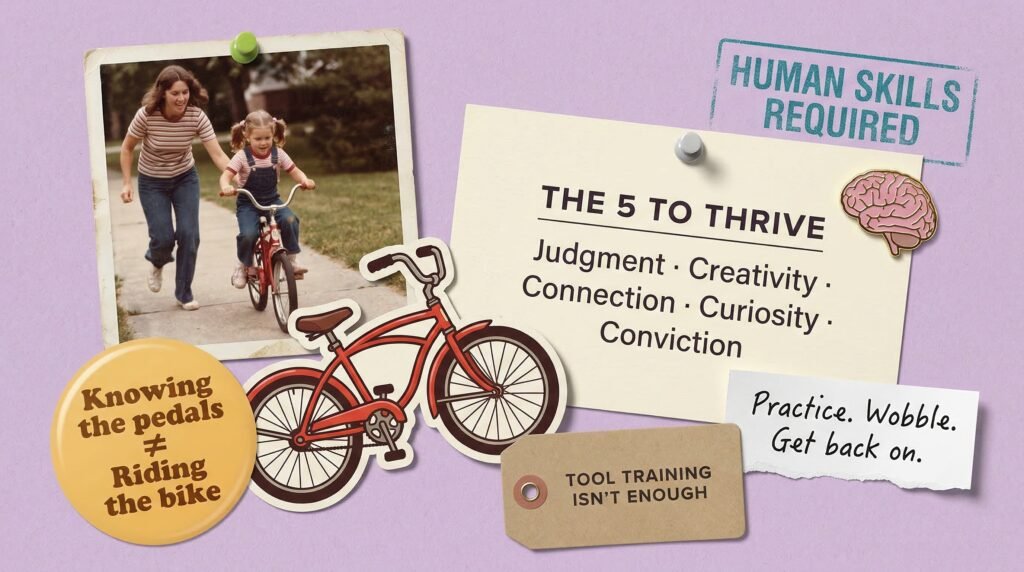
My older daughter learned to ride a bike when she was six. I explained the whole thing in about ninety seconds: here are the pedals, here’s the brake, steer with the handlebars. She now understood everything a bicycle does. She still couldn’t ride it.
That took practice, wobbling, falling off, getting back on, and me running alongside her holding the seat until she found her balance. She could have figured it out alone eventually, but it would have taken longer and hurt more.
I was speaking recently to a roomful of small business owners and leaders, and I asked who had given their teams some kind of AI training. About a quarter of the hands went up. Then I asked how many had given them time to actually practice with it. Fewer than three hands. After the session, I got chatting with one of the attendees who, as it turned out, owned an AI consultancy. But when I asked about critical thinking programs or AI collaboration training for their team … nothing. They’d taught people where the pedals are. That was it.
This is the pattern everywhere, and Gartner is worried enough to predict that by 2026, half of all organizations will need “AI-free” skills assessments because critical thinking is actually atrophying from over-reliance on generative AI. And a Bright Horizons study found that 42% of employees expect their role to change significantly because of AI, yet 42% also say their employer expects them to figure it out on their own.
In other words, “here are the pedals, good luck, try not to hit a tree.”
Where Tool Training Runs Out of Road
Most AI training right now is tool training. Here’s ChatGPT. Here’s the interface. Here’s how to write a prompt. And that’s fine as far as it goes, but it doesn’t go very far.
McKinsey found that as AI takes on more routine work, the human contribution is shifting toward framing better questions, validating outputs, and applying judgment. The skills aren’t disappearing. Where and how we use them is what’s changing.
So which human skills actually matter most? I’ve been digging into the research from the World Economic Forum, McKinsey, Workday, and others, and the same capabilities keep showing up. I’ve pulled them together into a framework I call the 5 to Thrive. (Yes, I named it. Yes, I’m proud of the fact that it rhymes. #languagenerd)
Companies are teaching people where the pedals are and wondering why nobody’s riding.
The 5 to Thrive
Five human capabilities that become more valuable, not less, as AI gets better.
1. Judgment
Can your team tell when AI is confidently wrong, or are they just accepting things because the output looks polished? Judgment is knowing when to question, when to push back, and when to say “I’m not buying that.” It’s the most in-demand human capability across almost every piece of research I’ve read, and it’s the one most at risk from over-reliance on AI. (My dogs are also very confident. Doesn’t mean I trust them to run the business.)
2. Creativity
AI is very good at generating variations on existing patterns. What it can’t do is come up with a genuinely new idea rooted in your specific context, your market, and your understanding of what your customers actually care about. Creativity in the AI era isn’t about volume. It’s about the spark.
3. Connection
Building trust, reading the room, knowing when someone needs a phone call instead of an email. If you read my recent post on the Delegation Dial, this is the meaningful end of the spectrum. And 83% of leaders say AI is making these human skills more important, not less.
4. Curiosity
The drive to keep questioning, experimenting, learning, and the resilience to keep going when it doesn’t work the first time. Or the second time. Or the seventh. The World Economic Forum ranks curiosity and lifelong learning as one of the fastest-rising skills globally, and I’d add that curiosity is also what breeds adaptability. Which is how your team handles whatever comes next.
5. Conviction
When AI makes it easy to sound like everyone else, conviction is what keeps your work distinctly yours. It’s standing behind your values, your brand, your point of view, even when the path of least resistance is letting AI smooth everything into sameness. You’ve probably heard me say that AI is raising the floor so, the best need to be building their Second Story Strategy. This conviction is what protects your Second Story. It’s critical to your competitive advantage that can’t be copied.
AI can make your team faster. Only these five skills can make them better.
Putting the 5 to Thrive to Work
Here’s your homework. Three things you can do this week.
1. Assess. Rate yourself or your team across all five: Judgment, Creativity, Connection, Curiosity, Conviction. Where are you strong? Where are the gaps? Be honest, not generous. (If everyone scores themselves a 9 out of 10 on Judgment … that might actually be a judgment problem.)
2. Buddy up. Pair people with complementary strengths. Your strongest critical thinker next to your most creative risk-taker. Your most empathetic connector with someone who has conviction in spades. Skills grow faster when they rub up against each other, and your team gets more resilient when strengths are shared rather than siloed.
3. Build it into your AI systems. This is the one I get most excited about. Design your AI workflows and agents to actively develop these skills during use, not bypass them. An agent that surfaces three options and asks “which one and why?” is building judgment. One that flags generic-sounding output and asks “what would make this distinctly yours?” is building conviction. If your AI tools aren’t encouraging human thinking while people use them, they’re quietly eroding it. (And remember that Gartner stat about critical thinking atrophying? This is how you prevent it.)
If your AI tools aren’t encouraging human thinking during use, they’re quietly eroding it.
• • •
The Leader’s Job Right Now
Your team doesn’t need another workshop on which buttons to push. They need time to practice, permission to get it wrong, and someone willing to run alongside them while they figure it out.
That’s you.
If that’s a conversation your audience needs to hear, my keynotes are built for exactly this. Let’s talk about bringing it to your next event.
Frequently Asked Questions
What is the difference between AI tool training and AI thinking skills?
AI tool training teaches people how to use specific platforms, like navigating ChatGPT or writing prompts. AI thinking skills are the human capabilities that determine whether those tools produce genuinely good results: judgment to evaluate output, creativity to push beyond generic answers, and critical thinking to spot when AI is confidently wrong.
McKinsey found that as AI absorbs routine work, the human contribution shifts toward framing questions, validating outputs, and applying judgment. Most training programs focus on the tool, not the thinking, and that’s where the gap lives.
What are the 5 to Thrive skills for working with AI?
The 5 to Thrive are five human capabilities that become more valuable as AI improves: Judgment (evaluating output and making sound decisions under ambiguity), Creativity (generating genuinely new ideas AI can’t originate), Connection (building trust and navigating relationships with empathy), Curiosity (the drive to keep learning and the resilience to persist through setbacks), and Conviction (standing behind your values and brand when AI makes sameness the easy path).
These capabilities are drawn from research across the World Economic Forum, McKinsey, and Workday, which consistently identify them as the skills AI cannot replicate and that increase in strategic value as AI capability grows.
Why is AI causing critical thinking skills to decline?
Gartner predicts that by 2026, half of organizations will need “AI-free” skills assessments because critical thinking is atrophying from over-reliance on generative AI. When people accept AI output without questioning it, the habit of evaluating and thinking independently weakens over time.
The most effective fix is designing AI workflows that require human judgment at specific checkpoints, so critical thinking stays active rather than optional. An AI agent that asks “which option and why?” keeps people thinking. One that just delivers a finished answer lets the muscle atrophy.
How should leaders support their team’s AI skill development?
Leaders support AI skill development most effectively by providing dedicated practice time, investing in thinking skills beyond tool training, and visibly using AI themselves. A Bright Horizons study found that 42% of employees say their employer expects them to learn AI on their own, which leads to inconsistent adoption and widening skill gaps.
Teams adopt AI faster when they see their leaders trying, stumbling, and improving openly. Pairing team members with complementary strengths and creating space to experiment without fear of failure accelerates development far more than another training session on which buttons to push.
How can AI tools be designed to build human skills instead of replacing them?
AI tools build human skills when they include prompts and checkpoints that require active thinking rather than passive acceptance. An agent that presents multiple options and asks “which one and why?” builds judgment. One that identifies generic output and asks “what would make this sound like your brand?” builds conviction and creativity.
The goal is designing workflows where the human contribution becomes more visible and more necessary during use. When AI tools are built this way, they make the people using them sharper, more discerning, and more confident in the skills AI can’t replicate.
What is the AI skills gap and why doesn’t more training fix it?
The AI skills gap is the disconnect between the AI capabilities organizations need and what employees can actually deliver. Only 35% of leaders report having a mature AI upskilling program, and where training exists, it typically focuses on tool mechanics rather than the thinking skills that drive business impact.
More training doesn’t close this gap because showing someone how a tool works isn’t the same as building the judgment, creativity, and critical evaluation to use it well. That takes practice, feedback, and support, which is what most organizations still aren’t providing.