The Delegation Dial: Knowing When AI Should (and Shouldn’t) Take the Wheel
I love asking audiences this question: Would you rather talk to a human or a bot?
Everybody says human. Every. Single. Time. And then I challenge them. “Do you want to have to talk to a person to make an airline reservation?” “Would you rather talk to a human if it meant you could only do it between the hours of 9-5 with a break from 12-1 for lunch?” The hands start to drop.
Back in my student days, I worked the phones at a Hyatt reservations center. (Fun fact: Omaha was the home of telemarketing in the 90s, thanks to our smooth accents and inoffensive time zone … lol) Anyway, picture it … rows and rows of us, headsets on, scripts in front of us, saying “I’m so sorry about the hold, how can I help you today?” roughly four thousand times a shift. Reserve a room. Cancel a reservation. Send me a receipt. Reserve a room. Cancel a reservation. Send me a receipt. I’m not going to lie, there were stretches where I could have easily been replaced by a parrot with a booking system, let alone a bot.
Now flip that around. This still happens today … I’m sitting at home biting my nails waiting on medical test results for my mom, and what do I get? An email that says, “Your results are now available. Please log in to the patient portal to view.” The patient portal where I can’t remember my password. And naturally, it’s after hours. Nobody is picking up the phone. And now I’m spiraling and staring at a “reset password” screen like it personally offended me.
Same me in both scenarios. Wildly different emotional stakes. And that, in my experience, is the part most organizations aren’t digging deep enough in their quest for automations. They’re making the “human or bot” decision based on what’s cheapest or fastest, not based on where their customer actually is emotionally.
Everyone’s Automating. Few Are Thinking About It.
McKinsey’s 2025 State of AI report found that 88% of organizations are using AI in at least one function. Sounds like progress, right? Except only 6% qualify as high performers actually seeing meaningful financial impact. That’s a lot of organizations spending money on AI without getting much back, and a good chunk of that might be because they’re automating and AI’ing the wrong things.
A Zendesk global survey tells the same story from the customer side. 52% of consumers are comfortable with AI handling everyday tasks. But when something goes wrong financially, 58% immediately want a human.
People aren’t anti-AI. They’re anti-AI-in-the-wrong-moment.
Introducing the Delegation Dial
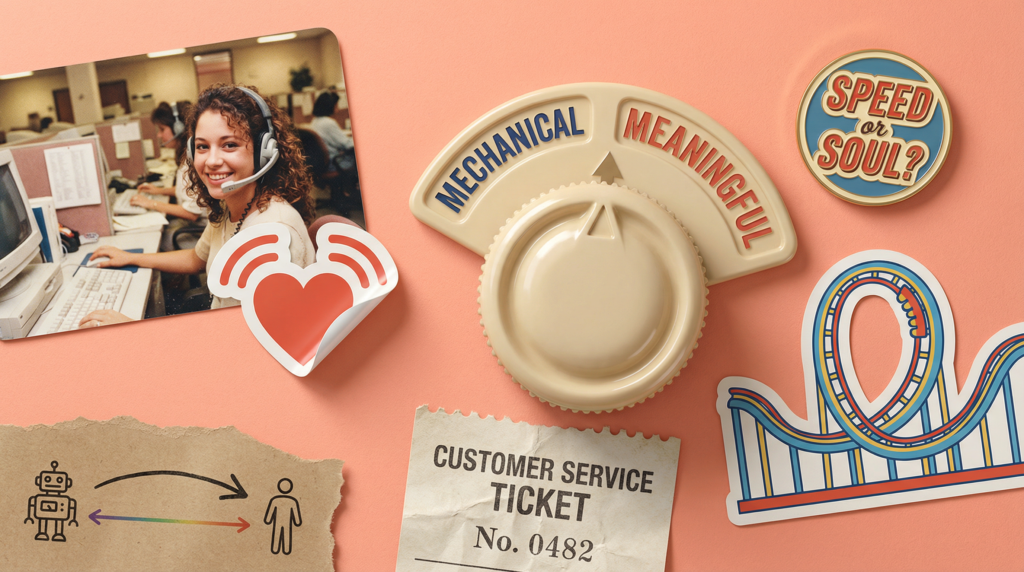
Most people treat this like a binary: automate or don’t. But perhaps think about it as a dial, not a switch. I call it the Delegation Dial.
On one end: mechanical. Low emotional investment, routine, transactional. People want speed.
On the other: meaningful. High emotional investment, complex, relationship-driven. People want connection.
The mistake? Treating everything like it’s at the same point on the dial.
Password resets, appointment reminders, booking confirmations? Nobody wants a personal phone call. They want it done. Now. And the research agrees, 62% of people actually prefer chatbots for simple requests. When emotional investment is low, speed and convenience ARE the experience.
My patient portal meltdown? That’s the other end. I wasn’t looking for efficiency. I needed someone who understood I was scared. And 86% of customers agree, empathy matters more than speed.
When emotional stakes are low, speed is the experience. When emotional stakes are high, connection is.
Where We Get This Wrong (and Right)
Let’s take sales as an example. Cold outreach? Top-of-funnel prospecting? That’s solid mechanical territory, a volume play where AI can identify prospects, personalize touchpoints, and qualify interest. Now, mechanical doesn’t mean sloppy or impersonal. In fact, our ability to use AI to make those outreaches more personalized and more relevant is one of the biggest wins in this space right now. Being on the mechanical end of the dial isn’t about doing a subpar job. It’s about deploying the right resource for the moment.
But renewals? Negotiations? Those unexpected moments when a client says, “We’re thinking about going in a different direction”? Those are meaningful. Those require a human who can listen, read the room, and respond with genuine care.
Keep in mind that there’s a lot of nuance here because the dial moves. The same client who was fine with an automated reminder last month might need a human conversation today because their business is under pressure. If you’re not paying attention, you’ll automate a moment that needed a human touch.
The Land of a 1000 Dials
Our experiences with a brand are complex and constantly changing based on internal and external factors. Over the years, I’ve done dozens of customer journey maps that, when done from the clients’ perspective, feel like a roller coaster. Each twist and turn, up and down, moment of conversation and day of silence is a different dial.
But the benefits of going through an exercise like this are massive. Not only can you identify friction points where AI can smooth out a process, but you can hopefully spot opportunities where you should be leaning even more into that human connection moment.
Reading the Dial: Three Questions
Before you automate any interaction, here is a task and 3 questions you can start with:
Task: Map their journey (customers, prospects, employees, partners, whoever!). This will give you a solid foundation and a real picture of what’s happening at a moment in time, as well as before and after that moment. Here’s a link to my Customer Journey Prompt, this will help with this process (you’re welcome!).
Questions:
- How emotionally invested is this person at this stage of the process or in this moment?
- What happens to trust (and our brand reputation) if we get this wrong?
- Would they rather have this resolved in 10 seconds, or feel heard for 10 minutes?
Hybrid AI-human models boost customer satisfaction by 12 to 27% compared to either approach alone. It’s really not about choosing but rather placing each one where they do their best work.
AI doesn’t need to do everything. It needs to do the right things, so your people can do the things that actually matter.
• • •
Your Homework
Map your customer touchpoints against the Delegation Dial this week. Where are you wasting human talent on mechanical moments a bot could handle in seconds (and deliver faster results for your clients/customers)? And where are you automating meaningful moments and quietly eroding trust?
Fix those first. This is an ongoing project for my business, and the opportunities and clarity we are gaining have certainly surprised us.
Most importantly, be open to injecting human-ness into even those seemingly AI moments. Remember my Hyatt headset? One of my favorite memories was a couple who called in, clearly stretching their budget for a romantic getaway. They were so hopeful and so careful with every dollar, and I managed to find them a honeymoon suite, complete with strawberries and champagne, on a special rate they didn’t even know existed. I could hear them celebrating on the other end of the line. That call was good for me as a human as much as it was for them. No bot in the world could have read the excitement in their voices and understood what it meant to them.
That’s the meaningful end of the dial. And it’s worth protecting.
If that sounds like a conversation worth having for your team or your next event, I’d love to help. Drop me a note and let’s talk about it.
Frequently Asked Questions
How do you decide which customer interactions to automate with AI?
The best way to decide is by evaluating the emotional investment of the person on the other end. Low-emotional-investment, routine interactions like password resets, appointment reminders, and order tracking are strong candidates for automation. High-emotional-investment interactions involving complex problems, financial stakes, or relationship moments should stay with humans.
Before automating any touchpoint, ask three questions: How emotionally invested is this person right now? What happens to trust if we get this wrong? Would they rather have this resolved in 10 seconds or feel heard for 10 minutes? The answers tell you where each interaction sits on the spectrum from mechanical to meaningful.
When should businesses use AI instead of human customer service?
Businesses should use AI for high-volume, transactional tasks where customers prioritize speed and convenience over personal connection. Research shows 62% of consumers actually prefer chatbots for simple requests, and 74% want them for quick questions that don’t require complex problem-solving.
The key is transparency about AI use and always providing a clear path to a human when the situation demands it. Customers aren’t anti-AI, they’re anti-AI-in-the-wrong-moment. When emotional stakes are low, speed and efficiency are what people actually want.
Why do customers lose trust when companies use AI without transparency?
Customers lose trust because discovering they’ve been unknowingly talking to AI feels deceptive, even if the AI performed well. The moment someone realizes they’re interacting with a bot they thought was a person, the immediate emotional response is feeling conned, and trust that took years to build can disappear instantly.
Zendesk found that 84% of consumers believe human interaction should always remain an option, and transparency around how AI makes decisions is one of the top three factors that increases people’s willingness to use AI tools.
What is the biggest mistake companies make with AI automation?
The biggest mistake is deciding what to automate based on cost or speed without considering the emotional context of the interaction. McKinsey’s 2025 report found 88% of companies use AI but only 6% are high performers, often because AI is deployed in the wrong places.
Automating a meaningful moment, like a client raising concerns about their contract or a patient waiting on medical results, doesn’t just fail to help. It actively damages trust and can cost the relationship entirely.
Why does hybrid AI-human service outperform full automation?
Hybrid AI-human service outperforms full automation because different moments require fundamentally different things. Research shows 86% of customers say empathy matters more than speed, while 62% prefer chatbots for simple, straightforward requests. No single approach delivers both.
Organizations using hybrid models see a 12 to 27% boost in customer satisfaction compared to either purely automated or purely human approaches. AI resolves routine interactions instantly, freeing human agents to focus on complex, emotionally charged moments where they make the biggest difference.
How should sales teams use AI without damaging customer relationships?
Sales teams should use AI for mechanical, high-volume activities like cold outreach, prospect identification, and initial qualification, where speed and scale matter most. Being on the mechanical end doesn’t mean doing a bad job. AI’s ability to personalize outreach at scale is one of the biggest wins available right now.
Renewals, negotiations, and unexpected client moments require a human who can listen, read the room, and respond with genuine care. The key nuance is that the dial moves: a client who was fine with automation last month might need a human conversation today if their circumstances have changed.
What is the Delegation Dial?
The Delegation Dial is a framework that helps leaders decide when AI automation is appropriate and when human interaction is essential. It positions every customer interaction on a spectrum from mechanical (low emotional investment, routine, transactional) to meaningful (high emotional investment, complex, relationship-driven), rather than treating automation as a binary on-or-off decision.
The core insight is that the variable isn’t the task itself, it’s the emotional stakes of the person on the other end. The same interaction can sit at different points on the dial depending on the customer’s situation in that moment, which is why leaders need to evaluate emotional investment, trust risk, and whether the person needs speed or presence.