The Job You Didn’t Apply For
I notice the language before I notice anything else. People tell me they gave it a go and what came back was useless, or that they had to redo the whole thing themselves, or that they’ve finally worked out how to get something decent out of it. Every one of those is a sentence about managing somebody. Nobody hears it that way, because there’s no person on the other end, but the grammar of management is already sitting there in how we talk about the work.
There was no promotion meeting and HR didn’t send a card. You didn’t get promoted, you got the responsibility anyway, and somebody still has to brief the work, give it the context it’s missing, judge what comes back, and put their name on the result.
AI has turned management from a job title into a working skill.
The Tools Arrived Long Before the Training Did
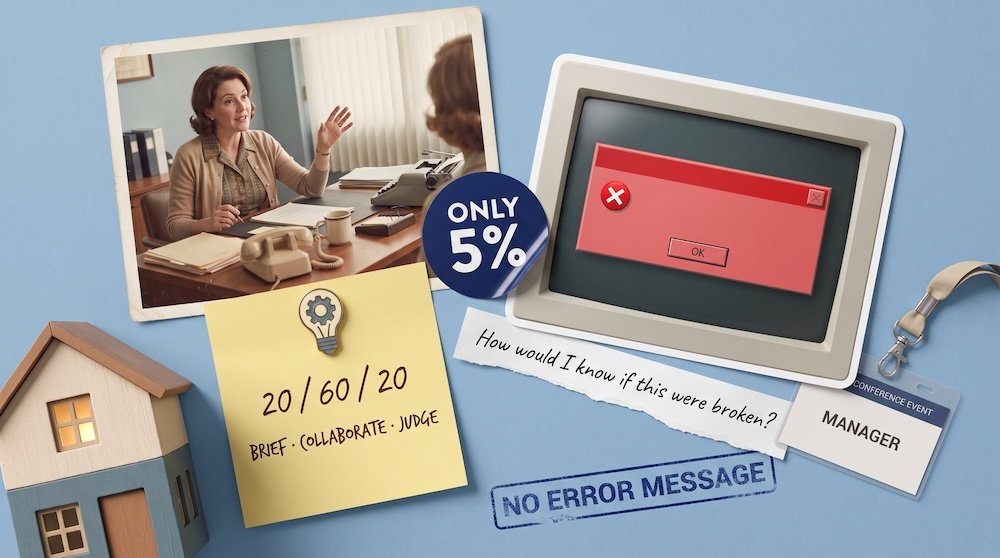
About 5% of people use AI in ways that genuinely change how they work. That’s EY’s number, from 15,000 employees across 29 countries, and the 88% who use AI at all are mostly running basic searches and summaries. So putting a tool in somebody’s browser turns out not to be the same thing as changing how work happens. (Anyone who has lived through a software rollout could have told them that, free of charge.)
Then KPMG and the University of Texas at Austin did something better than a survey. They analyzed 1.4 million real workplace AI interactions from 2,597 users over eight months, watching what people did rather than what they said, and again about 5% stood out.
What separated them is more interesting than the number. They weren’t the most technical people, or even the heaviest users. They framed the problem properly, gave the model a role and real examples, asked it to explain how it got there, and worked it over several exchanges instead of taking the first draft. Which is not a description of clever prompting. It’s a description of managing somebody well.
It’s also, I suspect, why so many of the calls I get now are about critical thinking rather than tools. People know something is changing … they just aren’t sure how yet.
Your New Colleague Will Never Roll Its Eyes
I’ve always found managing people can be difficult, and the hardest part usually turns out to be the most useful one. People have their own agenda. They want the promotion, they don’t want the weekend work, they think your plan is wrong and they’d quite like you to know it. That pushback is one of the most valuable things a team gives you, because somebody tells you your brief makes no sense before a minute of work gets done.
AI will challenge you if you ask it to. What it won’t do is volunteer, because it has no stake in the customer, the decision, or what happens after you press send. The friction that used to arrive free is now something you have to create on purpose.
AI Can Fail With Excellent Formatting
Twenty-odd years of software trained all of us to read a completed process as a successful one. The file saved, so it saved, the formula returned a number, so the number was right, the report generated at 6am, so the report was fine. When something went wrong, the software told you, usually in red, usually rudely. Error messages are an underrated gift and nobody has ever thanked one.
AI doesn’t work that way. When it’s wrong it produces something that looks precisely as finished, as confident and as well organized as when it’s right, and hands it over in the same pleasant tone. The failure mode of a language model is fluency, which means the warning signal you’ve relied on your entire working life simply isn’t there anymore.
Which is why that Microsoft Research and Carnegie Mellon study still matters at eighteen months old, because it’s the clearest data we have on this. Across 319 knowledge workers and 936 real examples of AI use at work, they found that the more confidence people had in the tool, the less critical thinking they did, while the more confidence people had in themselves, the more they did. Trust and scrutiny move in opposite directions, and the tools get more trustworthy every quarter.
AI never crashes. It just gets things wrong in a very nice font.
So the Friction Has to Come From You
Which is the whole reason the 20-60-20 Collaboration Equation splits the work the way it does.
The First 20%
Everything before AI touches anything. You decide what you’re handing over, who it’s for, and what good would look like. This part can’t be delegated, because if you can’t describe the work you can’t direct it, and you’ll settle for whatever sounds plausible.
The Middle 60%
The collaboration itself. The back and forth, the examples, the version where you say no, more like this. The sophisticated 5% lived in this middle stretch while everyone else took the first answer and went to lunch.
The Last 20%
Yours again, and the work that sometimes gets skipped and certainly gets scrimped on. Verify it, apply your judgment, and decide whether it’s ready to leave the building.
I spent years as a product manager and one habit stuck harder than the rest, which is that you don’t ship anything until you can say how you’d know if it were broken. Not “does this read well,” because reading well is exactly the trap, but “what would be true if this were wrong, and can I go and check that.” That question is the closest thing to an error message you’re going to get.
How hard you check should track what happens if you’re wrong. A list of ideas for the team offsite and a recommendation affecting somebody’s career don’t need the same scrutiny, which is a relief, because nobody wants a governance process standing between them and the sausage rolls.
Delegating the task never delegates the accountability.
If You Lead People, You’re Managing the Weather Too
All of this applies whether you lead 500 people or have never supervised anyone. Formal leaders just carry a second job, because you’re also setting what responsible AI use looks like for everyone watching you.
Permission on its own doesn’t create capability. People need examples, boundaries, practice, and proof that experimenting is genuinely safe, which mostly means watching somebody senior try something and get it wrong in public. (Yes, that means you.) Teams who only ever see polished results learn to hide the messy middle, and the messy middle is where judgment gets built.
Why Any of This Is Worth the Effort
Your competitors have the same tools on the same desks, bought in the same month. AI is raising the floor for everybody, and standing on a rising floor just means keeping up if you’re lucky. The 5% aren’t ahead because of the software, they’re ahead because of what they bring to it, and using that rising floor as a springboard to build a second story, something recognizably yours, is the whole game now.
• • •
Your homework this week is a bit more uncomfortable than usual, which is generally a good sign. Take the most recent thing your AI produced that you were pleased with, the one you passed on without a second thought, and go and find the mistake in it. There’ll be one, or a place where it hedged something you didn’t notice it hedging. Then ask yourself whether you’d have caught it under normal conditions.
If you lead people, add one more question. What is your team learning about AI from watching you?
If your organization is wrestling with critical thinking, AI delegation, or what leadership actually looks like now, this is the conversation I bring into keynotes and workshops. Let’s talk.
Frequently Asked Questions
What is an AI manager?
An AI manager is anyone who directs, reviews, or takes responsibility for work produced with AI. No title required, no technical role, nobody reporting to you.
If you give AI an assignment, supply the context it lacks, improve what comes back, or act on what it recommends, you’re already doing the job. The framing matters because people treat AI as a tool they use rather than a worker they direct, and tools don’t need briefing, standards, or feedback.
Do I need technical skills to manage AI?
No code required. What you need is one engineering habit, which is asking how you’d know if this were wrong before you need the answer.
The KPMG and UT Austin research found the sophisticated 5% weren’t the most technical people or the heaviest users. They were the ones who framed problems clearly, gave examples, asked the model to explain its reasoning, and kept refining.
How is managing AI different from prompt engineering?
Prompting is the instruction for a single task. Managing covers the whole relationship, from deciding whether AI should touch the work at all through to signing off on the result.
A good prompt improves an answer. Good management is what makes the answer accurate, relevant, and worth putting your name on.
Why is it a problem that AI is so agreeable?
AI will challenge your thinking if you ask it to, but it never volunteers, because it has no stake in the customer or the decision.
A colleague who spots a hole in your brief usually says so unprompted, and that free quality control is the thing you lose. The friction has to be something you build in deliberately instead.
How much should I check AI’s work?
Match the checking to the consequences. Casual brainstorming needs very little, while financial advice, client commitments, or anything affecting somebody’s career needs a proper human checkpoint with a named owner.
The useful discipline is deciding what you’d check before you start rather than glancing hopefully at the output afterward.
Does using AI make me worse at my job?
It can, and the research is specific about when. High confidence in the AI correlates with less critical thinking, while high confidence in your own expertise correlates with more, which means your own competence is the thing protecting you.
Used the other way round, AI sharpens thinking rather than dulling it. Ask it to argue against your position, find the weakness in your plan, or tell you what you’ve assumed without checking.
What should leaders do first?
Use it visibly, and let people see the attempts that didn’t work. Then define what responsible use looks like in concrete terms, because most teams are currently guessing.
Teams pay far more attention to what their leaders actually practice, question, and verify than to any policy document, which is either a problem or an opportunity depending entirely on what you’re modeling.