Apparently, I Was in Sales
I was a reluctant sales professional. It wasn’t a job I ever applied for.
The first time I officially became a salesperson, I worked for a small software company that needed someone to cover a territory. I was asked to take it on and assured I would be trained.
There was training, though it mostly happened while I was already doing the job, which was very efficient and slightly terrifying in equal measure.
In some ways, sales was simply the next stop on my accidental tour through every role in a software company.
Need a training and certification program? Ask Julie, she’ll figure it out. No partner program? Julie can build one and negotiate the agreements. Product design, a customer advisory program or the kitchen trash? Also Julie.
My career plan was basically a long series of people saying, “Julie will figure it out,” followed by me figuring it out.
Luckily, those jobs had already taught me how to ask good questions, listen for what wasn’t being said, connect the dots and take responsibility for the result.
AI can strengthen every one of those skills, and the best salespeople are using it to research before a call, rehearse difficult conversations and follow up with more relevance. The customer experiences someone who understands their business, remembers what matters and arrives ready to help.
Salesforce’s 2026 State of Sales surveyed 4,050 sales professionals and found that top performers were 1.7 times more likely to use prospecting AI agents than underperformers. No magic robot required. Top performers have built small moments of AI assistance into the work that happens before the customer sees it.
Customers feel the quality of your preparation, even when they never see the tools behind it.
Five Invisible AI Habits Worth Copying
The strongest AI habits begin with a specific sales moment, and the tool comes later. Which is less exciting than announcing a company-wide AI transformation, but considerably more likely to produce something useful.
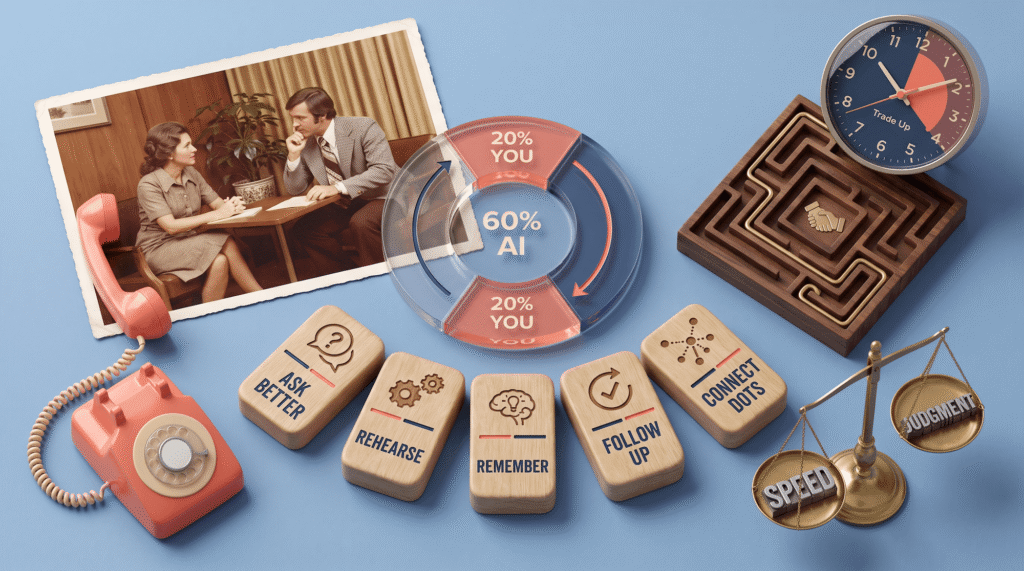
The 20-60-20 Collaboration Equation works beautifully here. The salesperson owns the first 20% by setting the goal and adding customer context. AI handles the messy middle by researching, comparing, organizing or drafting. The salesperson owns the final 20% by checking the work, applying judgment and taking responsibility for the result.
That loop can improve almost every stage of selling, but these five habits are especially worth looking for in your best people.
1. Curiosity before the call
Great salespeople rarely walk into an important conversation with a blank page and a generic list of discovery questions. They arrive with informed curiosity, knowing enough about the customer to ask better questions without pretending they already know the answers.
AI can review public information, approved CRM data, recent announcements and changes in the customer’s market. Ask it what’s changed, what might matter and which assumptions deserve testing, then choose the questions that actually belong in the conversation.
Done well, this preparation feels thoughtful. Done badly, it can feel as though the salesperson has been peering through the customer’s curtains. Human judgment knows the difference.
2. Rehearse the conversation you hope you won’t have
Great salespeople think ahead to the objection, awkward question or skeptical executive who could change the direction of a meeting. AI is a wonderfully patient role-play partner, even when you ask it to become the CFO who has heard the same promise from three competitors already.
Tell it to push back, challenge your assumptions and interrupt when your answer becomes vague. If it cheerfully applauds everything you say, you have created a very supportive but completely useless rehearsal partner.
AI can help expose the wobbly parts of your message, but the salesperson still has to read the room, adapt in the moment and know when the customer needs a better answer or simply a little space to think.
3. Give every conversation a memory
Great salespeople remember the detail that mattered, the question that went unanswered and the promise someone made three meetings ago. Customers notice when they don’t have to keep reintroducing themselves to a company they already know.
With approved systems, AI can organize meeting notes, identify commitments, surface unanswered questions and compare the conversation with previous interactions. The salesperson verifies the record and decides what matters for the next conversation. A transcript can capture the words, but humans often notice the weight behind them.
Of course, customer information belongs only in tools your organization has approved. A brilliant memory becomes considerably less brilliant when it creates a data problem along the way.
4. Follow up like you were actually listening
A great follow-up moves the conversation forward. It captures decisions, answers the open questions and makes the next step easy, preferably before everyone has forgotten why they were meeting in the first place.
This is a perfect 20-60-20 moment. The salesperson identifies what mattered and what was promised. AI organizes the information and drafts a useful response. The salesperson checks every detail, adds warmth and makes sure the message sounds like it came from someone who was actually in the conversation. How novel!
A polished follow-up sent in six minutes is impressive only when it is accurate. Fast nonsense is still nonsense, just punctual.
5. Zoom out from the next task
Great salespeople can spot connections across customers and opportunities, but that becomes harder when the next call, email or target is demanding all their attention.
AI can scan approved account information for related needs, stalled opportunities, repeated challenges and customers who may benefit from something else the company already provides. The salesperson decides which connections are genuinely useful and which would feel opportunistic.
Sometimes the best growth opportunity is revenue already sitting in the room, waiting for someone to connect the dots. If you have ever spent Friday afternoon wrestling a spreadsheet to find those dots, this may feel slightly miraculous.
The best AI habits give good sales judgment more chances to show up.
AI Will Save You Time. Make Sure You Trade Up.
AI is already giving sales teams meaningful time back. Gartner found that it saves sellers an average of 4.8 hours each week, yet 72% of sales organizations report low reinvestment of those savings into higher-value sales activities.
That’s a little heartbreaking. We’ve all spent years wishing for more time, and now that AI is handing some back, too many organizations are pouring it straight into more email, more meetings or a slightly longer list of admin. We have quite enough of that already, thank you.
One phrase I’ve started using is Trading Up your time. When AI takes something repetitive off your plate, make a deliberate choice to reinvest that time in something more valuable.
Use it to call a customer and ask how things are going. Use it to stop by for a visit (crazy, right?). Spend ten extra minutes thinking about what they may need next, coach a newer salesperson, or build another AI habit that creates even more capacity for human connection.
Trading Up doesn’t mean every saved minute has to become another piece of measurable work. Sometimes the most valuable use of that time is a better conversation, a stronger relationship, or enough space to think before you act.
McKinsey’s 2026 B2B Pulse research found that, among growth leaders embedding AI into their core workflows, 59% cited greater seller efficiency and 53% reported better customer experiences. Those numbers belong together. Saved time becomes a sales advantage when people reinvest it in better preparation, better conversations and better follow-through.
Sales leaders have a role here, too. If the saved hours simply disappear into bigger targets, the team will experience AI as a demand for more output. Make the trade visible. Say, “We saved this hour, and we are reinvesting it in our customers.”
AI may save your time. Your advantage comes from Trading Up what you do with it.
Your Homework: Steal the Good Stuff
Your strongest sellers may already have useful AI habits hiding inside their individual routines. One person has a brilliant pre-call workflow, another pressure-tests proposals, and someone else spots cross-selling opportunities the rest of the team walks straight past.
Choose one recurring sales moment and ask a strong performer to show you exactly how they handle it. Find out what they contribute, where AI helps, what they change and which parts they always keep human. Then write down the useful pattern so someone else can try it.
Please don’t begin with, “Who is using AI?” That question usually produces a list of tools and a suspicious amount of nodding. Instead, ask what your best people do before, during and after a high-stakes customer moment. That’s where the advantage is hiding.
Try the process three times, improve it, and then ask whether the customer received something more relevant, useful or thoughtful because you worked this way. If they did, you have found an invisible AI habit worth spreading.
If you want help finding the habits already hiding inside your sales team and turning them into repeatable practice, drop me a note. This is exactly the kind of practical AI shift I love helping teams make.
• • •
• • •
Frequently Asked Questions
What are invisible AI habits in sales?
Invisible AI habits are small, repeatable ways salespeople use AI to improve customer-facing work without making the technology the center of the experience.
They might include researching an account before a meeting, rehearsing a difficult objection, organizing call notes, improving a follow-up or looking across existing customers for patterns. The customer may never see the AI doing its part, but they experience better preparation, stronger relevance and more dependable follow-through from the salesperson.
How are top salespeople using AI?
Top salespeople use AI to support preparation, practice, analysis and follow-through throughout the sales cycle.
They may use it to understand a prospect’s business, identify useful questions, role-play a conversation, summarize approved meeting notes or explore opportunities across a portfolio. Strong sellers still decide what matters, provide the context, check the output and take responsibility for every customer-facing decision. Their expertise directs the AI instead of disappearing behind it.
How can AI help with sales prospecting?
AI can help salespeople research prospects, identify buying signals, prioritize accounts and prepare outreach that reflects what is happening in a customer’s business.
Good prospecting begins with a clear definition of the right customer and reliable information about the account. AI can process that context quickly, but the seller must decide whether the resulting message is accurate, useful and appropriate. A beautifully polished email is still a bad email when it is beautifully wrong.
Which sales tasks should always retain human ownership?
Salespeople should retain ownership of relationship decisions, sensitive conversations, promises, negotiation judgment and final customer communication.
AI can prepare options, summarize information and help someone rehearse, but it can’t be accountable to the customer. The salesperson must decide what is appropriate, verify the facts and stand behind the outcome. When someone says, “I’ve got you,” the customer needs to know a real person means it.
How does the 20-60-20 Collaboration Equation work in sales?
The 20-60-20 Collaboration Equation keeps the salesperson responsible for the beginning and end of AI-assisted work while AI handles much of the processing in the middle.
The first 20% covers the goal, customer context and definition of a good outcome. AI then supports research, comparison, analysis or drafting. In the final 20%, the salesperson verifies the result, adds judgment, adjusts the tone and personalizes it for the customer. The percentages are a reminder about ownership, not a stopwatch.
How can sales leaders spread effective AI habits across a team?
Sales leaders can spread effective AI habits by observing how strong performers handle specific sales moments, documenting what works and giving others a simple way to try the same process.
Ask someone to demonstrate how they prepared for a recent meeting, where AI helped and what they changed before using the result. Capture the trigger, required context, approved tool and human checks. A repeatable pre-call habit is far easier to teach and improve than a general instruction to “use more AI.”
How should salespeople protect customer data when using AI?
Salespeople should use only organization-approved AI tools and follow company rules for confidential, personal and commercially sensitive information.
If the policy is unclear, don’t paste customer information into a public AI tool and hope for the best. Ask the appropriate security or data owner what is permitted. You can also use anonymized or fictional information while testing a process, then move it into an approved system once the rules and safeguards are clear.
Does using AI make sales less personal?
AI can make sales more personal when it gives salespeople greater capacity to listen, prepare and respond thoughtfully.
Problems arise when teams automate the relationship itself or send unchecked generic content at scale. Used well, AI handles research, organization and first drafts quietly in the background while the seller brings curiosity, judgment and connection to the customer. More useful human contact is the goal, with AI helping to make room for it.