The Could-Do List
I’ve never gotten more done in my life. And I’ve never had more left to do.
Both of those things are true at the same time, which is either a paradox or just Tuesday, I haven’t decided. If you’re feeling some version of that yourself, a bit exhilarated, a bit frazzled, a bit guilty that AI was supposed to make all this easier and yet here you are vibrating gently at your desk … stick with me. I want to tell you why it’s happening, because it’s not quite what it looks like, and it isn’t a personal failing. Then I’ll share the boundaries I’ve been putting in place to cope, since I’m very much in the thick of this one with you.
Let me show you what I mean by frazzled. On any given day I’ve got four or five AI conversations open at once, a couple of agents grinding away on something in the background, and I’m bouncing between all of it like a human strobe light, fully convinced this is what peak productivity looks like. It’s exhilarating. Over a single weekend recently I built a working application, start to finish, something that genuinely wasn’t possible for me eighteen months ago. (Did I need to build it? We’re not going to examine that too closely.) Last week I whipped up a custom image for a blog post in about ninety seconds, the kind of thing I used to either pay for or do without. The tools aren’t underdelivering. They’re delivering more than I was promised, and they’re letting me do things I couldn’t do at all before.
So this isn’t a complaint. I want to be clear about that up front, because so much AI writing right now is either breathless hype or quiet doom, and this is neither. The tools are extraordinary. The trouble, if you can even call it that, is that all this new capability arrived without an off switch, and nobody handed me a manual for what to do when suddenly you can do almost anything.
Because the shift was somewhere else entirely, at least for me. It was never really about saving time. The time savings are real but modest, and honestly beside the point. A recent Section report surveying five thousand knowledge workers found that 68% of people using AI at work save four hours or less per week from it. (I’d assumed that number would be higher, and I say that as a card-carrying true believer.) Four hours is lovely, I’ll take it, but four hours was never the prize. The prize is the explosion in what’s possible. And possibility, as it turns out, doesn’t clock out at five.
Nathaniel Whittemore, who writes and talks about this stuff more clearly than almost anyone, has a name for the feeling, and the moment I read it I felt thoroughly seen. He calls it the infinite backlog. The idea is that AI didn’t so much give us time back as it made the entire universe of things we could be doing suddenly feel reachable and urgent. Every project that used to live safely in the someday pile is now something you can pull off … so the whole pile comes rushing into the present at once. The work doesn’t feel finished because, for the first time, finished isn’t a thing anymore.
I used to keep three lists
Long before any of this, I had a little personal system. Three lists.
There was the To-Do list, the stuff I intended to do soon. There was the Should-Do list, where things went to accumulate guilt, like that standard operating procedure I’d been meaning to update since, conservatively, the last presidential administration but one. And then there was the Could-Do list, the dreamy one, full of the projects that would genuinely move the needle if only I had the time, the team, or the skills to pull them off.
The Could-Do list was the fun one precisely because it wasn’t going anywhere. Those items got to stay aspirational, parked just out of reach, asking nothing of me. There’s a real and underrated comfort in a list you’ve happily made your peace with never finishing.
Then AI came along, reached right up onto that dreamy shelf, and started cheerfully handing me the items one by one. Build the app? You can do that now. Create the image? Ninety seconds. Run the analysis you never had the bandwidth for? Off you go, have fun. The thing that used to keep those three lists separate was a constraint, time and capability, and that constraint mostly dissolved. So everything became a could-do, and every could-do started to feel like a should-do, and all of it lands as a right-now. Three tidy lists collapsed into one gloriously, exhaustingly endless one.
That’s what I’ve started calling it, the Could-Do List, capital letters and all. It’s my name for what it feels like to live inside Nathaniel’s infinite backlog. We used to keep a to-do list. Now we’ve got a could-do list, and that is a very different and far more seductive animal.
(A could-do list this long isn’t a sign you’re behind. It’s a sign of how much just became possible for you. The pile is evidence, not indictment.)
Abundance is the gift. Boundaries are the skill it now demands.
This is the part I had to grow up about.
When you can only get to three things, the sheer impossibility of the other thirty does your prioritizing for you, automatically and for free. You don’t have to decide what not to build, because reality decides for you. It’s not a glamorous system, and no system that runs entirely on you being too busy ever is, but it’s a system, and it ran in the background my whole career without me ever once thanking it.
Take that constraint away, hand someone near-infinite capability, and the deciding suddenly becomes the job. Nobody’s choosing for you anymore. And choosing, it turns out, is genuinely harder than doing ever was, because every option on the table is now a real, live, achievable thing rather than a comfortable fantasy you could wave off.
So AI didn’t take anything away from me. It gave me almost everything I asked for, and in doing so it handed me a responsibility I’d never had to hold before, deciding where to point all of this. The abundance is the gift. The boundaries are the skill the gift now demands, and most of us, myself very much included, never had to develop that muscle because the limits were always external. Now we have to supply them ourselves. (Nobody warned me there’d be homework.)
Same gift, two ways to overwhelm
This plays out between people too, not just inside my own head, and it’s worth naming because it’s straining a lot of teams right now.
When a leader looks at someone and says “surely you could just do that with AI, it’ll only take five minutes,” what’s happening is that a could-do is being handed over as if it were a to-do. A former needle-mover, the kind of thing that used to live on the fantasy shelf, gets treated as a quick errand. And the honest reply is usually “I could, sort of, but not well, and not on top of the eleven other newly-possible things you mentioned this morning.” (The five-minute estimate, by the way, never includes the forty-five minutes of explaining to the AI what you actually meant.)
That gap is the same three-list collapse, just happening across two people instead of one. The leader sees infinite possibility and reads it as infinite capacity. The person standing in the backlog is the one who has to figure out which of the suddenly-possible things is genuinely worth doing right. Which is why the boundaries can’t only be the ones I set for myself. They have to be ones we set with our teams too, out loud, on purpose. Possible is not the same as free, and “AI could do this” is not the same as “this is worth doing, by you, this week.”
The risk isn’t doing less. It’s doing the same.
There’s a strategic trap hiding in all this abundance, and it’s the part I care about most.
The instinct, faced with an infinite list of things you can now do, is to simply do more of them. Add another agent, open another conversation, become a faster and faster processing engine for the never-ending pile. And you can. But everyone else with the same tools can too. If we all just race to clear the same newly-possible list at top speed, we all end up producing more of the same stuff, faster, and looking remarkably alike while we do it.
The advantage comes from choosing the right things to do, and doing them in a way only you would. The floor came up for all of us, that’s what AI is, a rising floor. What you choose to build on top of it is the only part that’s yours. So the goal is now to create more deliberate and intentional lists, and the work has shifted from finding options to choosing among them.
What I’m trying
So I’ve been experimenting with some boundaries, the deliberate kind, not the damage-control kind. I’m not handing these down from a mountaintop. I’m still practicing them myself, and I’m better at some of them on some days than others. But here’s what’s helping.
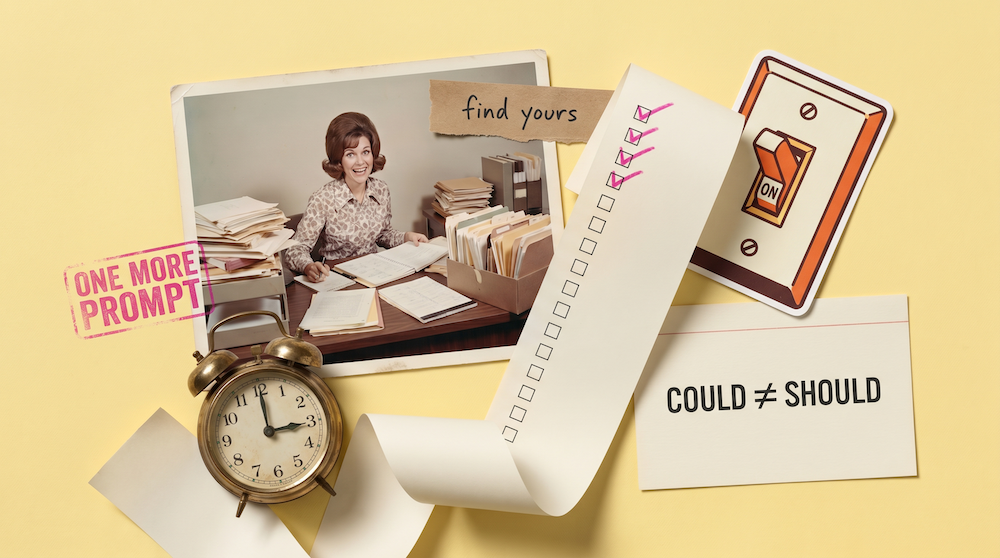
Decide what “done” looks like before I start. AI removed the natural finish line, so now I draw my own. Before I open the conversation I name the good-enough point out loud, otherwise I will cheerfully “one more prompt” my way into the sunset, chasing a polish that nobody but me will ever notice. (I have personally lost entire evenings this way. To be honest, more than I’d like to put in writing.)
Treat newly possible as a question, not a command. Just because I can build the thing this weekend doesn’t mean the thing has earned my weekend. Newly possible and newly worthwhile are not the same animal, and the new discipline, the one that didn’t used to matter, is asking “should this even be on the list?” before I let it land there.
Spend the freed-up time on purpose. When AI genuinely saves me a couple of hours, those hours have a sneaky way of getting reabsorbed into more work before I’ve even noticed they arrived … sigh. So now I try to claim them deliberately, for thinking, or rest, or an actual human being, before the Could-Do List wanders over and pockets them.
Balance the strobe instead of feeding it. This is the one that’s reshaped my days the most. When I kick off something that takes more than a few seconds (my personal patience threshold is roughly thirty seconds before a progress bar starts to feel like a personal insult), the temptation is to fill that little gap with more fast work, a sixth conversation, another quick win. That gap between “AI is working” and “AI is done” is the single most dangerous stretch in my day, because it’s exactly where I reflexively spin up another thread and the strobe gets worse. So now I pair one running, semi-automated task with one slow, genuinely involved piece of human work I can sink into while the machine churns. The agent drafts, I drop into the deep thing, I surface when it pings. Still switching, but between two things instead of six, and one of them feeds me rather than fries me.
End on the clock, not on the task. The work will never tell me it’s finished, because it can’t be. So the finish line has to be a time, not a state. The machine doesn’t get tired and never will. (It isn’t even smug about it. It simply does not care, which is somehow worse.) I do get tired, and that’s not a flaw to be engineered away, it’s the most honest signal I’ve got about when to stop.
Choose, on purpose, where to stay sharp. I’m offloading more and more to AI, and that’s genuinely fine, that’s the entire point of the thing. But it means I want to be deliberate about the few places I keep my own muscles warm, rather than letting it happen by accident.
My husband Paul is an unintentional master of that last one, though he’d be horrified to hear it framed so grandly. We live in a town built on a proper grid, a major road every mile, everything meeting at tidy right angles, genuinely difficult to get lost in. Paul will not drive somewhere he’s been a hundred times without the GPS narrating every single turn, and he is perfectly serene about it. I’m the opposite. I treat the drive as a small adventure, no navigation, occasionally finding traffic, mostly enjoying the satisfaction of working it out myself. But flip the script, and if Paul can’t remember the name of an actor in some film, he flatly refuses to look it up. He’ll let it rattle around in his head for a day, sometimes two, treating his own memory as a gym he simply will not skip, until he triumphantly dredges the name up from somewhere around 2009. We keep completely different muscles warm, and neither of us is doing it wrong. The point is that we each chose, deliberately, where to stay sharp and where to happily hand it off. In a world where the machine will gladly do all the navigating and all the remembering, making that choice on purpose is the whole game. Find yours.
• • •
One more prompt
Which brings me back to the phrase that loops in my head all day, and I suspect in yours too. I’m just one more prompt from the promised land. (Reader, I am not. There is no land. There is only the next prompt.)
I’ve come to think the promised land was never an empty list or a suspiciously quiet afternoon. The list isn’t going to end, and that’s not a personal failing, it’s just what happens when could-do becomes can-do for all of us at once. The promised land is getting good at deciding which prompt was worth sending, and getting comfortable leaving the rest of that glorious, infinite list right where it is.
The capability is a gift, an enormous one. The skill it asks for in return is knowing where to point it, and having the nerve to set the boundary yourself, since nothing else out there is going to set it for you.
When everyone can do everything, the advantage isn’t speed. It’s the nerve to choose.
So by all means, send one more prompt. Just make it a good one.
Frequently Asked Questions
What is the infinite backlog?
The infinite backlog is a term coined by Nathaniel Whittemore to describe how AI makes the full universe of things you could be doing feel suddenly reachable and urgent, so the work never feels finished. AI didn’t give people more time so much as it removed the limits that used to keep most of their potential work safely out of reach.
Before AI, the projects you never had the time, team, or skills for stayed comfortably in the someday pile. Now that you can do them, they all rush into the present at once. The result is a list that grows as fast as you work it, which is why so many people report feeling busier than ever even as the tools genuinely save them effort.
Why do I feel busier since I started using AI?
You feel busier because AI expanded what’s possible faster than it saved you time. The change isn’t a few reclaimed hours, it’s that tasks which used to be out of reach are now achievable, so far more work feels both doable and urgent.
The natural limit of “I simply can’t get to that” used to do your prioritizing for you. Remove that limit and every option becomes a live possibility competing for your attention, which feels like pressure even when the individual tasks are easier than they were before.
Does AI actually save time at work?
Yes, but less than most people expect. A Section survey of five thousand knowledge workers found that 68% of AI users save four hours or less per week, so the time savings are real but modest.
The more significant impact isn’t the hours saved, it’s the dramatic increase in what any one person can now produce or attempt. The strategic value of AI shows up far more in expanded capability than in a lighter calendar.
How do I avoid AI burnout?
Set deliberate boundaries, because AI removed the natural ones. Decide what “done” looks like before you start a task, end your day on a set time rather than waiting for the work to feel finished, and protect the hours AI frees up instead of letting them refill with more work.
Burnout in an AI workflow rarely comes from any single task being hard. It comes from the absence of a stopping point, since the work can no longer signal that it’s complete. The fix is to supply your own limits rather than expecting the work or the tools to provide them.
How can I stay focused when I’m running several AI tasks at once?
Pair one running, semi-automated AI task with one slower, more involved piece of human work, so you’re only switching between two things instead of many. While the AI processes in the background, drop into the deeper task rather than opening yet another conversation.
The riskiest moment is the short wait between starting an AI task and getting the result, because that gap tempts you into spinning up more parallel work. Filling it with one absorbing task instead of several quick ones turns frantic task-switching into something far more sustainable.
Why do leaders’ AI expectations feel unrealistic?
Because leaders often see AI’s infinite possibility and read it as infinite capacity. When a manager assumes a task will take five minutes “with AI,” they’re treating an ambitious, formerly out-of-reach project as a quick errand, without accounting for the judgment and quality control a good result still requires.
The gap is best closed by talking about it directly with teams. “AI could do this” is not the same as “this is worth doing well, by this person, this week,” and naming that difference out loud protects people from drowning in work that only looks instant.
If everyone has AI, where does competitive advantage come from?
Advantage comes from judgment, not speed. When everyone has the same tools and can produce the same outputs quickly, racing to do more just makes organizations faster at looking like each other. The edge belongs to those who choose the right things to work on and do them in a way only they would.
AI raises the floor of capability for everyone equally. What you choose to build on top of that floor, and what you deliberately decline to do, is the part competitors can’t copy. The goal isn’t a shorter list, it’s a more deliberate one.
Should I stop using AI for things I want to stay good at?
Not necessarily, but you should choose on purpose where you keep your own skills sharp rather than letting it happen by accident. Offloading most tasks to AI is fine and often the whole point. The key is to deliberately protect a few areas where you want to keep your own judgment and ability strong.
Different people will pick different things to keep doing manually, and that’s exactly right. The discipline isn’t avoiding AI, it’s making a conscious decision about which mental muscles are worth keeping warm in a world where the machine will gladly handle everything you let it.